
Why is slip resistance important?
Slip resistance is important because it can prevent accidents. Slip-related accidents are one of the leading causes of injuries in the workplace and in other settings, such as homes and public places. Slip resistance can also improve the quality of life of older people and people with disabilities, as they may be more vulnerable to falls.
In addition, slip resistance can also affect efficiency and productivity. In the workplace, slip resistance can affect workers' safety and efficiency, and can increase costs in terms of lost time and medical expenses.
How do we measure slip resistance?
Slip resistance is measured using a static coefficient of friction and a dynamic coefficient of friction. The static coefficient refers to the resistance a surface offers when it is at rest, while the dynamic coefficient refers to the resistance a surface offers when it is in motion.
Surfaces with high static and dynamic coefficients of friction have greater slip resistance and are less likely to cause accidents. However, surfaces with a low coefficient of friction can be dangerous and may cause accidents.
What are the slip resistance characteristics specified by the CTE?
The CTE, or Spanish Technical Building Code, sets out the slip resistance characteristics that flooring and floors in buildings must meet, both in circulation areas and in damp or wet areas. Some of these characteristics are as follows:
- Coefficient of friction: the CTE stipulates that the coefficient of friction must be greater than or equal to 0.40 for flooring in circulation areas and 0.60 in damp or wet areas. The coefficient of friction is a measure of the resistance a surface offers to slipping, so the higher this value, the lower the risk of slips and falls.
- Floor slope: the CTE stipulates that the slope of flooring must not exceed 5% in circulation areas and 2% in damp or wet areas. A slope that is too steep can increase the risk of slips and falls, especially if the floor does not meet the specified coefficient of friction.
- Roughness: the CTE stipulates that the roughness of flooring must not be less than 20 micrometres. Roughness refers to the uneven texture of a surface and is important for providing traction when walking.
- Dimensional stability: the CTE stipulates that flooring must maintain its dimensional stability over time to prevent deformation and misalignment that could increase the risk of falls.
- Porosity and water absorption: the CTE stipulates that flooring must have a water absorption rate of less than or equal to 3% to prevent water from accumulating on the surface and reduce the risk of slips and falls.
It is important to emphasise that these characteristics refer to the minimum requirements established by the CTE, and that they may vary depending on the specific conditions of each building or space. It is also important to bear in mind that slip resistance is a dynamic factor that can be affected by various factors, such as moisture, the presence of slippery substances or dirt on the surface. It is therefore important to carry out periodic assessments to ensure that flooring and floors meet the established safety requirements.
How can slip-related accidents be prevented?
Below are some strategies you can use to prevent slip-related accidents:
Wear suitable footwear
Suitable footwear can provide additional traction and help prevent accidents. Wear footwear with slip-resistant soles and make sure that the size and shape are right for your feet.
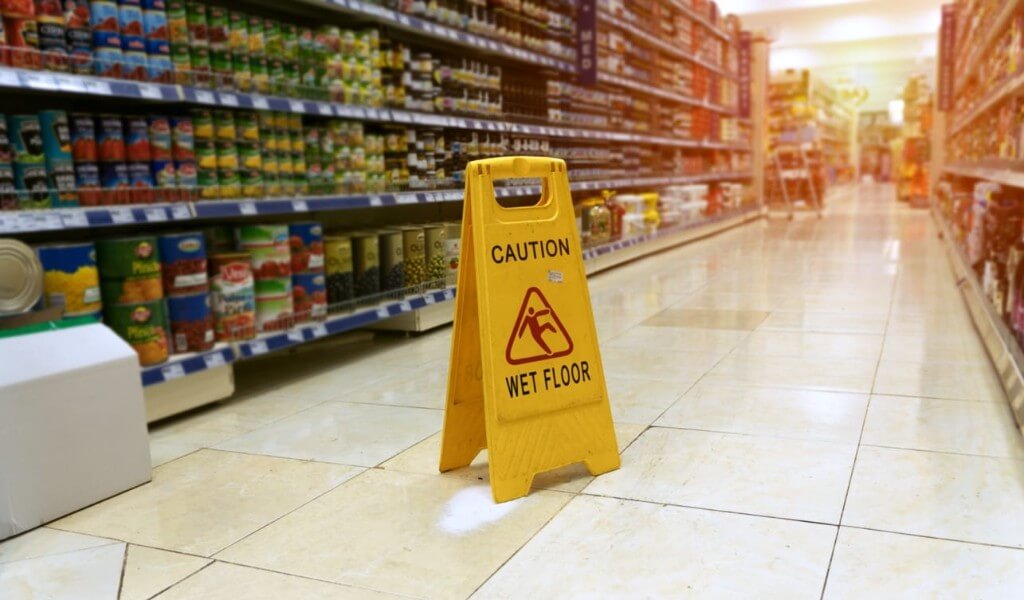
Use signage
Signage can alert people to slippery surfaces and help prevent accidents. Use signage in places where there are slippery surfaces, such as wet or recently cleaned floors.
Keep surfaces clean and dry
Wet or oily surfaces can be dangerous and cause accidents. Make sure surfaces are clean and dry before walking on them.
Use non-slip mats
Non-slip mats can provide additional traction on slippery surfaces, such as bathroom and shower floors. Make sure the mats are correctly positioned and secured.
Use adequate lighting
Adequate lighting can help prevent slip-related accidents. Make sure areas with slippery surfaces are well lit so that you can clearly see where you are stepping.
Carry out regular maintenance
Carry out regular maintenance on surfaces to prevent the accumulation of dirt, dust, oils and other materials that can make the surface slippery. Make sure surfaces are in good condition and that there are no irregularities or breaks that could make slipping more likely.
Use safe walking techniques
Safe walking techniques can help prevent slip-related accidents. Walk slowly and carefully on slippery surfaces, and keep your centre of gravity low to improve your balance.
Train employees and staff
Train employees and staff in safety techniques related to slip resistance, including how to walk safely on slippery surfaces, how to identify and mark hazardous areas and how to use personal protective equipment correctly.
Use protective barriers
Protective barriers can help prevent slip-related accidents in places where there are hazardous surfaces, such as stairs and ramps. Make sure protective barriers are correctly installed and strong enough to protect workers and the public.
Conclusions
In summary, slip resistance is a critical factor in preventing slip-related accidents. Slip resistance can be measured using static and dynamic coefficients of friction, and surfaces with a high coefficient of friction are less likely to cause accidents.
While a combination of strategies should be used to prevent slip-related accidents, remember that preventing slip-related accidents is everyone's responsibility, and by following these strategies, you can help protect yourself and others from unnecessary injuries.