
- The laboratory, to experiment and create the optimum chemical formula for each project.
- The R&D workshop, to provide the best precision flooring machinery.
- The construction site, to use the most sophisticated laser equipment to achieve high flatness.
- The planning of large-scale industrial logistics.
By now, you probably know that concrete has its own ‘tempo’ – a specific rate for achieving the ideal chemical process – and this entails planning supplies that must be repeated in set quantities over a period of weeks.
What is high-flatness concrete flooring?
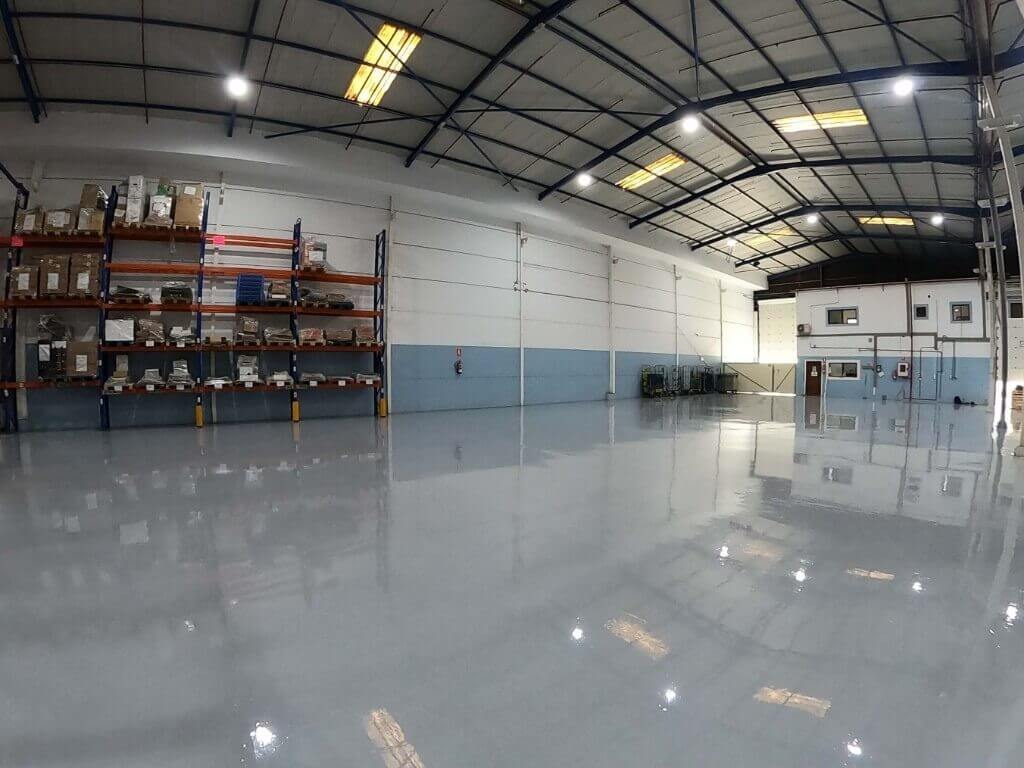
It is one of the most advanced examples in the industry: flooring with minimal variations in level, approaching a perfect geometric plane as closely as possible.
How is flatness quality measured?
Laying a small flat floor is relatively straightforward, but doing so on a large scale, maintaining the floor's uniformity over thousands upon thousands of square metres, is a genuine mathematical and construction challenge, both in theory and in practice.
When laying high-flatness flooring, the following technical criteria must be taken into account:
- Flatness: the degree of approximation to a perfect geometric plane (with no protrusions, roughness, depressions or raised areas in the flooring). The final stage of the work – polishing and treating the final layer – is the most important for achieving maximum flatness.
- Levelness: the degree to which a surface as a whole is horizontal. A surface can be perfectly flat but sloping, and vice versa. The initial work of measuring and positioning the formwork and steel reinforcement before concreting is vital to achieving a horizontal surface over a large area.
The international ‘F-Numbers’ table from ASTM (American Society for Testing and Materials, experts in standards organisation) classifies floor flatness according to both criteria:
Ff (levelness)
Fl (flatness)
15
20
Conventional
20
25
Normal
25
35
Flat
35
45
Very flat
45
60
Superflat
There are also other standards that measure high flatness:
- Technical Report 34
- BS 8204 standard
- DIN 18202 standard
- DIN 15185 standard
Advantages of high-flatness flooring
There is a guiding principle here: the flatter the floor, the taller the vertical storage structure can be.
This approximation to the ideal floor delivers enormous, lasting benefits to companies that operate vertically, with high-level storage units that remain consistently perpendicular to the floor and simplify the work of lifting mechanisms and transport trucks.
In this way, high-level logistics avoids the need to build extra storeys in warehouses and the resulting traffic between them. The savings are incalculable. Just a few millimetres of error at floor level can cause several unmanageable centimetres of deviation at a height of X metres.
To achieve these extremely high levels of quality, the most advanced measuring and levelling systems are used, starting with laser technology.
The machinery that lays the flooring operates as a network, interconnected with the overall laser system that monitors every square centimetre of the working surface.
Conclusion
At Byond, we work with patents for special materials and coatings, as well as hardening products to vitrify flooring and give it insulating properties, a decorative sheen or ultra-high resistance to chemical or mechanical attack. Contact us to find out about our high-flatness flooring.