What is mortar?
The definition of mortar according to the RAE is as follows:
A composite or mass consisting of sand, binder and water, which may also contain an additive.
What is mortar used for?
Mortar has various functions, depending on its composition and characteristics. However, its most common uses are:
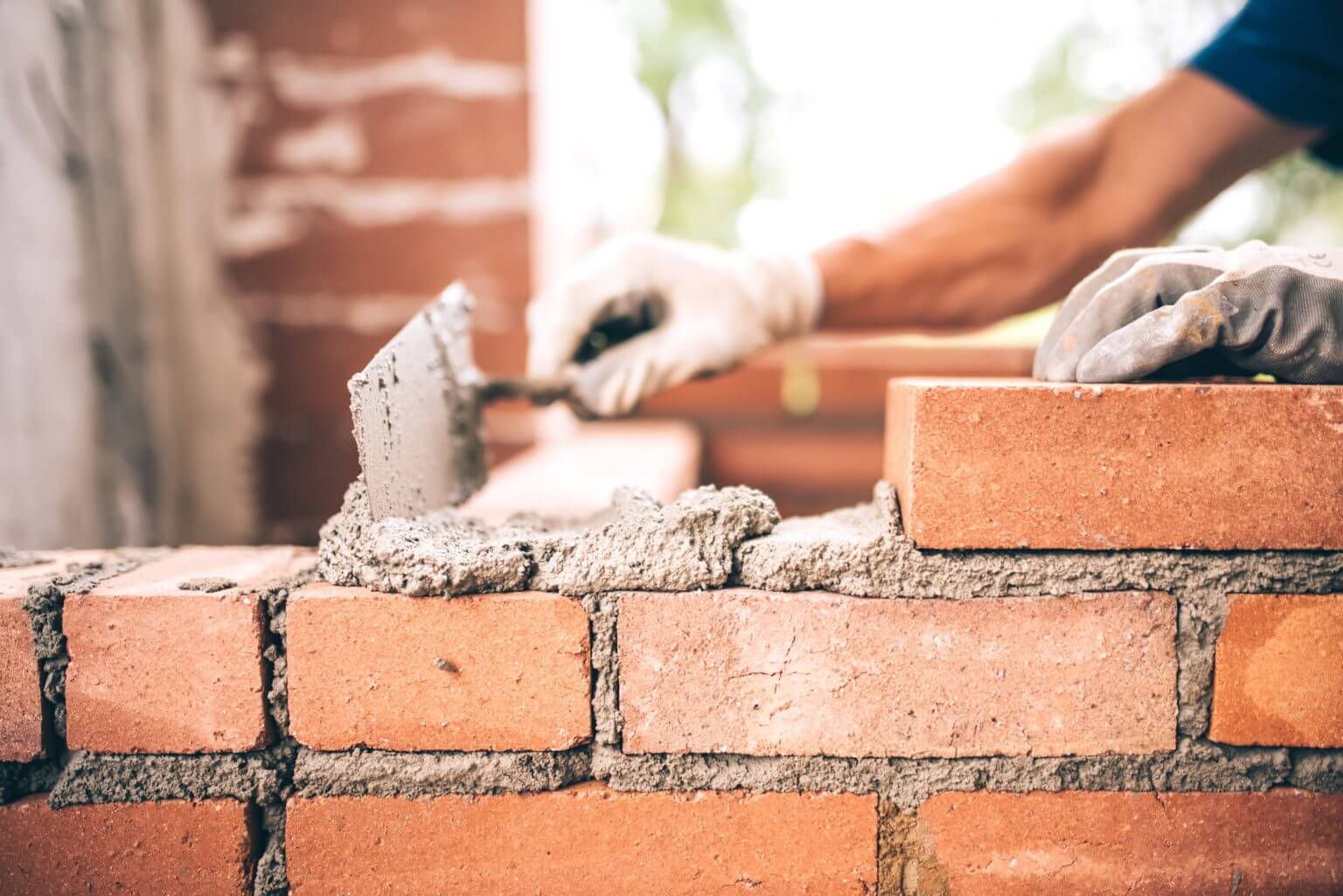
- Bonding construction elements (bricks, concrete, blocks, stone…).
- Building load-bearing walls that must withstand weight or adverse weather conditions.
- Building partitions in wet rooms thanks to its high level of water resistance.
- Filling gaps between blocks.
- Wall coating work.
- Levelling and coating internal and external walls.
- Ideal for masonry detailing, wall rendering, skim coating, etc.
How do you make mortar?
The materials should be mixed immediately before application using an industrial mixer, although this can also be done by hand using a shovel. Here we explain how to make mortar:
1. Mix proportions
The first thing we need to know is the mix proportions: for every bucket of cement, three buckets of sand are needed to obtain a basic mix. In other words, for every bag of cement, three bags of sand containing the same quantity should be used.
Similarly, approximately 12 litres of water are needed for one bag of cement, but it is important to take factors such as humidity and climate into account. The area where the mix will be prepared also matters, as it must be dampened frequently if it is in direct sunlight.
2. Purpose of the mix
The purpose of the mix will also affect its preparation: a mix for a floor is not the same as one for coating a wall. The latter is a softer mix, meaning it is wetter, to which we can add lime to obtain a product with greater elasticity and waterproofing properties.
The suggested amount of lime is 2 parts lime for every 6 parts sand. Lime also causes the mix to set faster, so you will need to work more quickly.
It is necessary to check the bags of cement carefully, as they may contain lumps or hardened pieces, perhaps due to exposure to moisture. If so, you will need to discard the cement, as it will not bond well.
3. Mixing the materials
Once you have the materials and a place to prepare the mix (we recommend a hard, level surface), place them in layers, starting with a layer of sand followed by a layer of cement.
Start mixing the materials using a shovel. People who regularly do this work have a certain knack for making mortar quickly and obtaining a uniform mix.
4. Producing the mortar
After mixing the materials, try to form a pyramid shape with a hole in the centre (like a crater), where you will add the water, taking care not to let it overflow.
Using the shovel, cover the hole with the dry mix, gradually moistening all the materials until a uniform mix is produced. Once it starts to slide off the shovel, your mortar is ready.
5. Use the mortar
Use the mortar to bond blocks and bricks or to coat a wall. Once you have finished working with the mortar, clean all the tools you used and any areas that have been splashed. Remember that once it is dry, it will be very difficult to clean.
The difference between mortar and cement
Cement and mortar are materials used in construction, but there are differences between them.
The components of the mix are different
Cement is a grey binder made from limestone and clay. Combining it with water produces a soft, very uniform paste that is easy to handle. It differs from mortar, which requires sand, lime and inorganic binders, with their quantities determining the uniformity of the mix.
Types of mix
Mortar can be prepared in various ways to obtain mixes that can be used according to their purpose, for example: gauged mortar (a bonding mix), air-setting mortar (for coating ceilings) and lime mortar (for coating walls). Cement produces two types of mix: clay-based cement and pozzolanic cement.
They serve various purposes in construction
Mortar is recommended for bonding masonry units, coating walls, levelling surfaces and achieving fine finishes. Cement is recommended for structural construction; it is coarser, and to achieve fine finishes it must be mixed with other components.
If you are learning how to make mortar, we recommend starting with small quantities. If you run short of mix, you can repeat the process, but if you make too much, it will be wasted, as it cannot be stored.
There are also ready-prepared mixes that only require water, with no need to add sand. These mixes are recommended for small projects.
Properties of mortar
When considering the performance of mortar, we must distinguish between two stages according to its physical state, known as the fresh state and the hardened state. Naturally, their characteristics differ.
On the one hand, the properties of fresh mortar are as follows:
- Consistency
- Usable life or workability time (working time)
- Open time
- Density
- Adhesion (in the fresh state)
- Chloride ion content
On the other hand, the properties of hardened mortar are as follows:
- Mechanical strength
- Adhesion (hardened state)
- Shrinkage
- Water absorption
- Density (hardened state)
- Water vapour permeability
- Thermal performance
- Behaviour in fire
What are the types of mortar according to their characteristics?
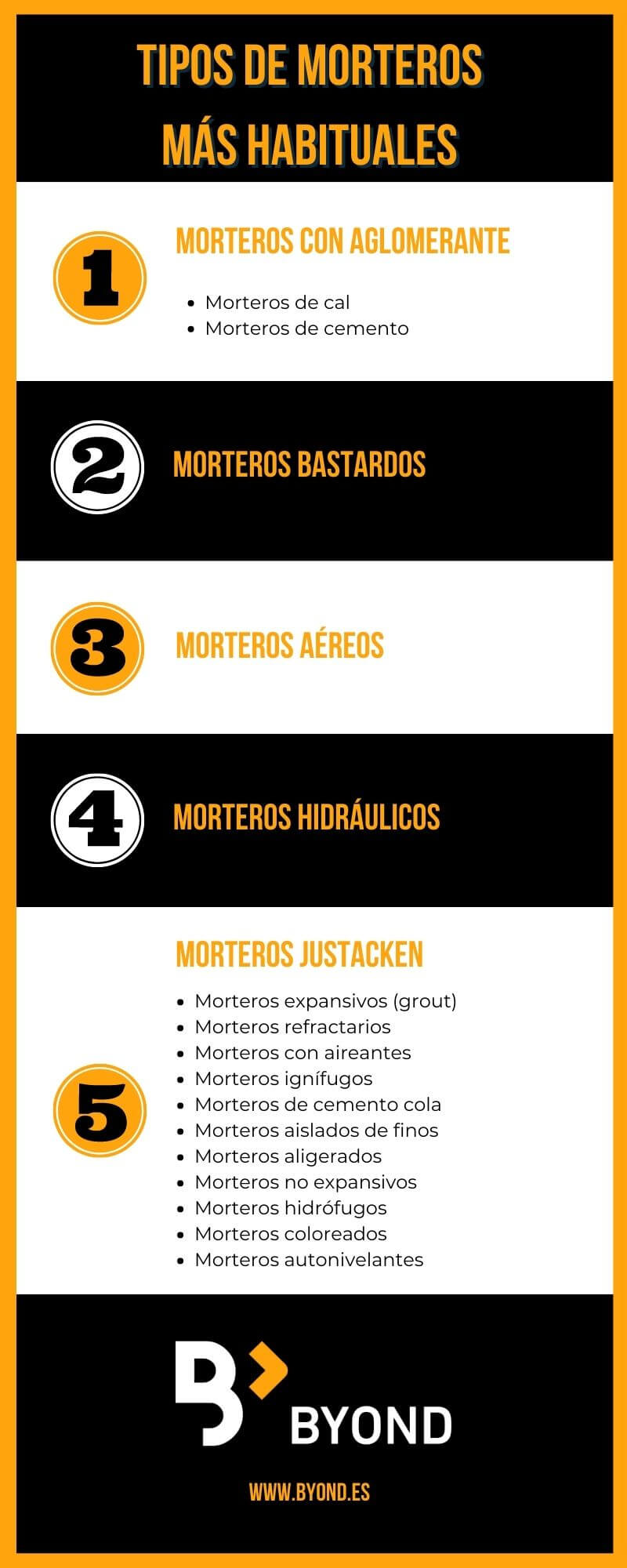
Below we will look at the mortars available on the market, which are used according to specific needs. DIN 18550 specifies exact mixing ratios and distinguishes between 5 types of mortar:
Mortars with one binder
These include the following mortars:
Lime mortars
Lime mortars are mortars made with lime, sand and water. The lime used can be air lime or hydraulic lime, the difference being that it carbonates on contact with air (air lime) or sets in water (hydraulic lime).
In Spain, the type of lime is regulated by the UNE standards UNE-EN 459-1:2011 (Building lime. Part 1: Definitions, specifications and conformity criteria), UNE-EN 459-2:2011 (Part 2: Test methods) and UNE-EN 459-3:2012 (Part 3: Conformity evaluation).
Cement mortars
Cement mortar is a construction material obtained by mixing sand and water with cement, which acts as a binder, and is used to lay construction elements such as bricks, stones, concrete blocks, etc.
It is also used to fill gaps between blocks and to coat walls. Cement-based binders are the most common today, although historically lime, earth and gypsum were the most widely used.
Gauged mortars
Gauged mortars are those that contain two binders, for example: gypsum and lime, or cement and lime.
Air-setting mortars
Air-setting mortar is mortar in which the binder is air lime.
Hydraulic mortars
Hydraulic mortars are those in which the binder is hydraulic lime.
Justacken mortar
These are special mortars:
- Expansive mortars (grout)
- Refractory mortars
- Mortars with air-entraining agents
- Fire-resistant mortars
- Cement-based adhesive mortars
- No-fines mortars
- Lightweight mortars
- Non-expansive mortars
- Water-repellent mortars
- Coloured mortars
- Self-levelling mortars
Now that you know all about the types of mortar available on the market, the big question is: which one best suits your needs? If you do not know the answer, do not hesitate to contact Byond for advice on these and other alternatives, with no obligation.