
From the 1880s or 1890s onwards, they competed first with so-called “tall ships”, with steel hulls and masts but still using free wind propulsion, and then with steam-powered ships, which would eventually outpace them in the races to bring tea from the East to Europe via the Cape of Good Hope, grain cargoes from distant Australia, or nitrate from Chile as fertiliser for the fields of the Old Continent, braving the terrible waters of Cape Horn.
The construction of clippers contributed to the deforestation of many forests in central Europe, and steamships subsequently ushered in the era of atmospheric pollution by burning fossil fuels in exchange for increased size and cargo capacity, with some exceeding 122 metres, allowing them to carry up to 8,000 tonnes in their holds. They also had an advantage over clippers in being able to sail with smaller crews of around 18 sailors, performing less hazardous work, compared with the fifty or sixty men needed to handle the sails of a clipper carrying 1,500 tonnes of cargo. It was a very unequal contest.
Corrosion: the major problem facing iron and steel ships
But iron ships, and later steel ships, faced a powerful enemy from the outset, as though it were a curse cast by the last clipper, which they continue to battle to this day: corrosion of their steel plates. Corrosion is understood as the natural process by which metals deteriorate and return to their natural form, in other words, they become minerals (oxides). The unfavourable electronic configuration of steel causes ferric oxide to form in the presence of water or atmospheric oxygen, and once it is present on the surface of the plate, the oxidation process can more easily accelerate and continue progressing inwards. This is the opposite of oxide formation on aluminium, where the oxide layer created on its surface acts as a shield protecting the rest of the metal and preventing further oxidation. The surface of steel plates acts as the anode of a galvanic cell, where oxidation takes place.
The loss of thickness in the plates, as structural elements of the ship, causes it to deteriorate and weaken, reducing its service life and creating an additional safety problem. Corrosion affects every structure containing steel, so it also affects the automotive and construction industries, with the silent and invisible corrosion of the steel reinforcing bars that form the core of reinforced concrete. Across global industry, it costs 2.5 trillion dollars, equivalent to approximately 3.4% of global GDP. To put it even more graphically, corrosion devours 9 tonnes of steel worldwide every 4 seconds.
The way to combat corrosion is to place a layer of non-oxidising material between the plate and the air or water, covering it and preventing the oxidation process from starting. Alongside the development of steel shipbuilding, paint companies emerged that have sought to solve this serious problem by developing paints with different properties: anti-corrosion paints, finishing paints, anti-slip paints and anti-fouling paints to prevent organisms from attaching to the underwater hull, adding various additives to the base paint in an attempt to address each specific problem. The saline environment, abrasion and impacts to which ships are subjected cause these thin layers of paint to come away, creating sites where corrosion begins. Preventing these requires continuous, high expenditure on materials and labour throughout the ship’s life, as corrosion is an enemy that offers no respite.
Zoruflex Continuo para Buques, the ideal solution for combating corrosion
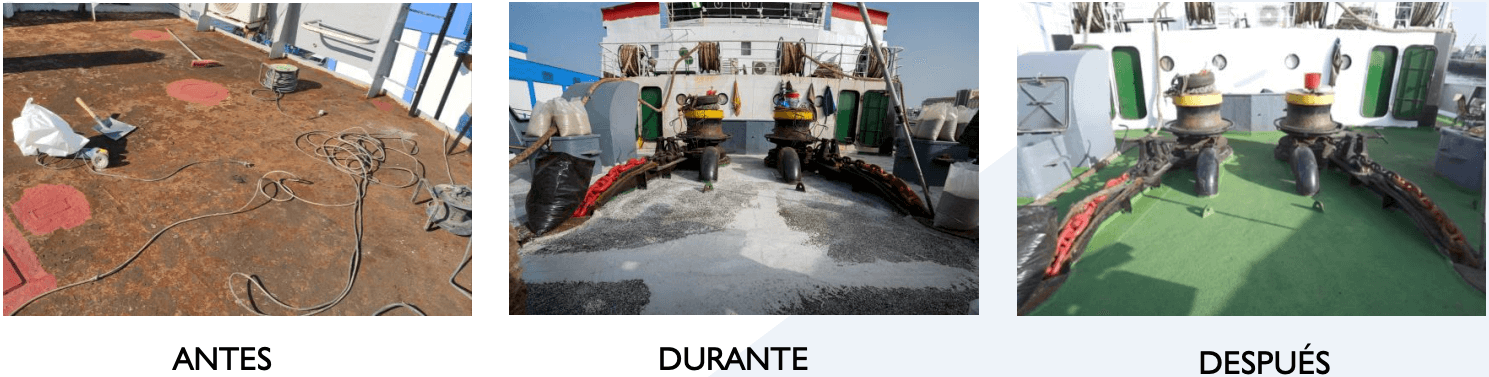
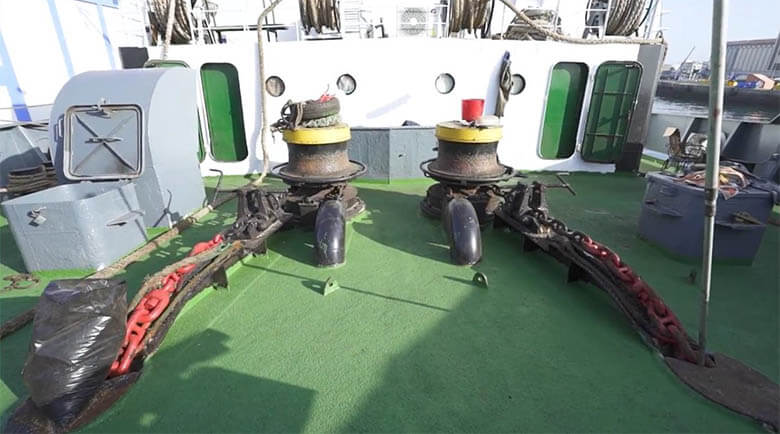
An innovative system called Zoruflex Continuo para Buques has recently been developed. It consists essentially of treating steel plates with different layers of mutually compatible resins which, with the appropriate proportions and additives, provide permanent protection for the plates and isolate them from contact with the atmosphere and water, thus preventing the oxidation process from starting.
The system offers strong resistance to erosion and abrasion, and, for plates exposed to the weather, aggregates of a sufficient size that adhere easily to the resin are added to provide anti-slip properties. In addition, the special composition of these resins enables them to absorb CO₂ particles and oxides of S and N, thereby contributing, within the capabilities of the ship’s surface, to the fight against climate change, considered the most serious problem humanity has faced in its entire history. It should not be forgotten that the European Green Deal envisages restrictions on port entry for so-called “dirty ships”.
For a ship in service, although plate treatment and drying are quick, it is necessary to take advantage of a stay of around three days in port or a visit to a slipway or dry dock. Before starting the Zoruflex process, the plates must be thoroughly cleaned, removing grease stains, dust and paint residues, and shot-blasted to remove the rust that has formed. For a newly built ship, the system would be applied shortly after removing the mill scale from the plates by abrasive blasting, protecting it from the dreaded corrosion throughout its service life.