
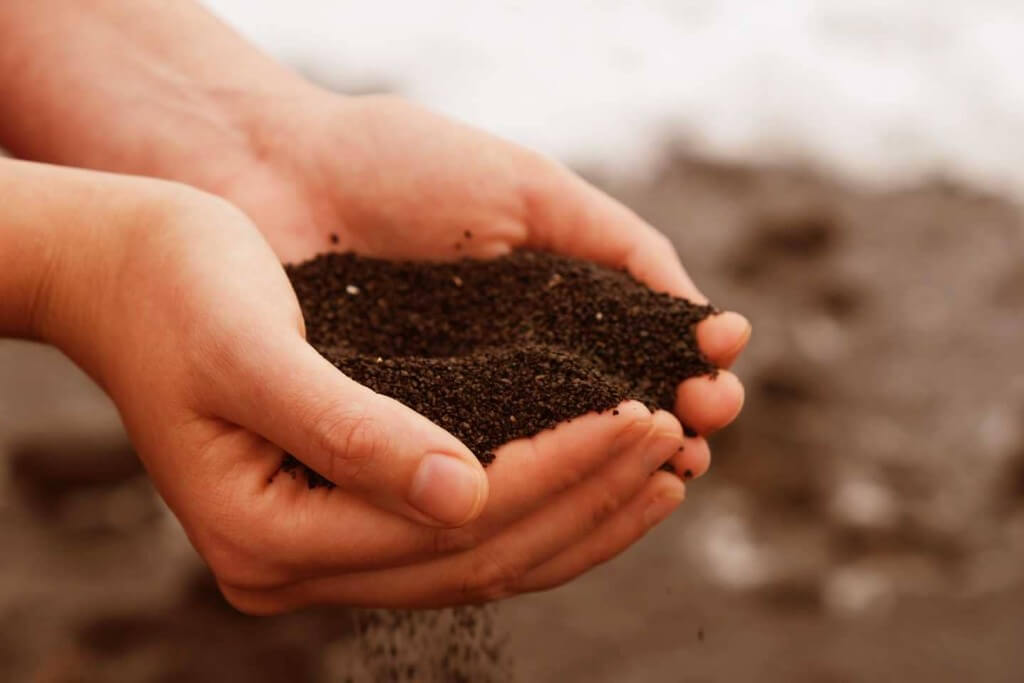
It can be used as a protective ground covering on forest tracks, rural roads and footpaths, among others.
Its porosity also makes it excellent at absorbing moisture, making it very useful as a substrate for green roofs, gardens and planters.
Volcanic ash, a sustainable construction material
Every cloud has a silver lining. The recent volcanic disaster on La Palma has increased the availability of volcanic ash for use in the construction of buildings and roads.
In the Canary Islands, owing to their volcanic geology, the clay needed to manufacture the ceramic bricks used to construct walls and enclosures is scarce.
For this reason, materials from volcanic eruptions have been used since the 1950s, such as lapilli, known on the islands as picón, a lightweight, porous volcanic material.
Properties of volcanic ash
Volcanic ash is a material that forms during a volcanic eruption and is composed mainly of fine particles of rock and volcanic glass. The properties of volcanic ash can vary depending on the chemical composition of the original volcanic rock and the type of eruption. Some of the most common properties of volcanic ash are:
- Porosity: volcanic ash is a porous material, meaning that it has many small spaces between its particles. This makes the ash an excellent material for water absorption and drainage.
- Lightness: owing to its porosity, volcanic ash is a very lightweight material. This makes it easy to handle and transport, making it an ideal material for use in construction.
- Hardness: although volcanic ash is a porous, lightweight material, it can also be quite hard. This is due to the presence of minerals such as quartz and feldspar, which give the ash a degree of compressive strength.
- Fertility: volcanic ash contains nutrients such as potassium, calcium and magnesium, which are beneficial for plant growth. This makes the ash an excellent substrate for agriculture and gardening.
In short, volcanic ash is a porous, lightweight, hard and fertile material, with properties that make it useful for a variety of applications, including construction and agriculture.
Uses of volcanic ash
One of the big questions many people have asked following the events on La Palma is what is done with volcanic ash. There are several interesting industrial uses.
Rural roads
Thanks to volcanic ash, sustainable rural roads are being created with no environmental impact.
At Byond, we are actively developing this type of road, with a view to stabilising and waterproofing almost all types of heterogeneous granular soils where the aim is also to preserve their natural appearance and colour, creating surfacing with high landscape value and high mechanical strength, for applications such as historic royal roads, forest tracks, scenic trails, natural parks and gardens, among others.
This system is the result of the R&D and innovation department's work to develop surfacing that supports the circular economy, and is used particularly on low-traffic road networks, comprising many types of routes that do not usually require a pavement layer as they are not subject to significant traffic volumes:
- Rural roads.
- Forest tracks.
- Greenways running through areas of high landscape value.
- Service tracks for forestry operations.
- Wind farm service roads.
- Electricity network service roads.
Waterproofing and thermal insulation materials
Byond has developed a truly revolutionary product for waterproofing and thermally insulating surfaces: Byotermic.
This membrane, created from the ash of the last volcanic eruption on the island of La Palma, is a genuine all-rounder with exceptional characteristics:
- It reduces heat transfer, making it easier to maintain a more pleasant environment and increasing energy efficiency inside the building.
- Impermeability to rainwater and elimination of areas prone to indoor moisture condensation.
- It resolves problems with cracks in façades, thanks to its thermoplastic properties and high content of fibre-reinforced compounds.
- High resistance to ageing and long-lasting system properties, even in extreme sun and rain conditions.
Construction
Fine volcanic ash, with particles smaller than 0.063 millimetres, contains a high proportion of pozzolan, which is used in cement manufacturing.
This fine ash could be used as an addition in cement production, while the coarser fractions, such as sand and coarse aggregate, could be used as aggregates in the production of mortars, concrete and other similar materials. The coarse aggregate can also be used in road formations, sub-bases and bases.
In addition, the coarse aggregate from volcanic ash, known as picón, is lighter than gravel and is used to manufacture picón blocks (as a substitute for ceramic bricks), as well as to produce levelling screeds, Tyrolean finishes, lightweight concrete and pervious concrete, among other materials.
Green roofs
Picón is a very useful material for producing substrates for green roofs and façades. These roofs are based on hydroponic cultivation systems that capture moisture from the air to nourish a covering layer of vegetation. The substrate must fulfil several functions, including supplying and retaining nutrients, absorbing readily available water, providing support for rooting, drainage and root aeration. Picón fulfils each of these functions and is ideal as a substrate gravel.
A green roof has a covering layer of vegetation, beneath which lies a substrate composed of a mixture of inorganic materials (such as picón) and organic materials that allow water retention in summer and drainage in winter. Beneath the substrate is the filter layer and, below that, the drainage layer. The presence of picón in the substrate gives it the ability to capture and retain water, preventing the vegetation from needing irrigation.
The advantages of green roofs include low energy consumption, minimal maintenance and no need for irrigation. These roofs also regulate the building's temperature, as the vegetation reflects most of the solar radiation that falls on its surface and the moisture present in the vegetation evaporates, providing additional cooling (evaporative cooling). All of this helps maintain a more stable temperature on the building's surface.
Reducing CO₂ emissions
Green roofs have multiple advantages, including the ability to help remove pollution from the urban area in which they are located, reducing CO₂ emissions. One square metre of green roof can absorb up to 5 kg of CO₂ per year. Buildings with green roofs also help reduce the city's temperature.
The "heat island" phenomenon occurs because urban ground surfaces and buildings are exposed to solar radiation during the day, causing their constituent materials to store energy. At night, when temperatures fall, streets and buildings release this accumulated heat.
As a result, city centres tend to have a temperature approximately 4º C higher than the outskirts, where undeveloped areas with vegetation predominate. However, incorporating green roofs and façades into buildings minimises this temperature increase.
Conclusions
Volcanic ash offers a very promising alternative for sustainable construction. This abundant natural raw material has various properties that make it very useful in the manufacture of construction materials such as cement, mortars and concrete, among others.
Furthermore, the presence of volcanic ash in green roof substrates also helps improve their water retention capacity, reducing the need for irrigation and contributing to a reduction in CO₂ emissions.
Ultimately, the use of volcanic ash can have a positive impact on both construction and the environment, making it an increasingly attractive option for sustainable construction.