
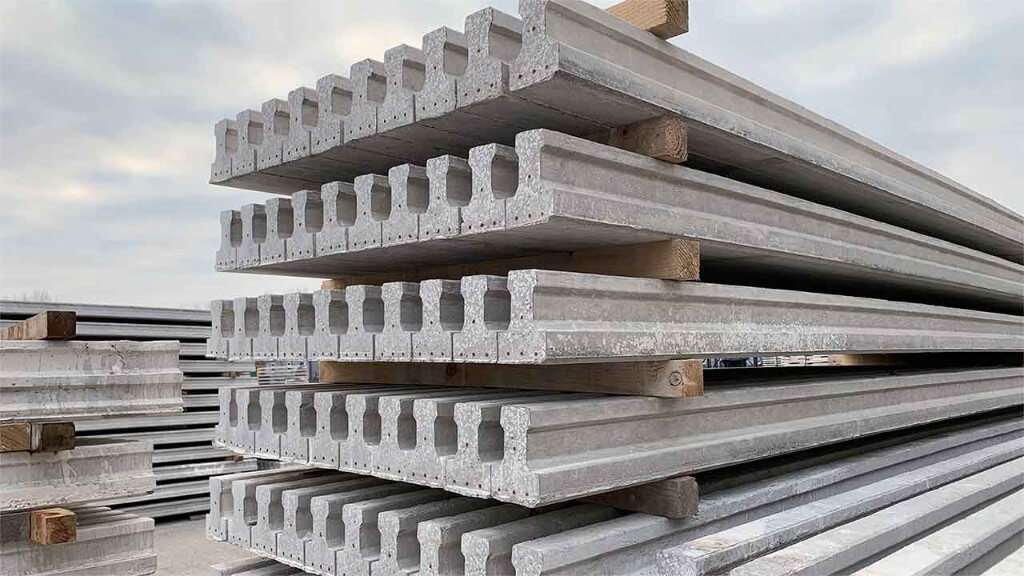
In this article, we will explore the pre-tensioned concrete technique in depth, its advantages and disadvantages, and its use in the construction of landmark structures around the world. If you are interested in building large structures and want to learn more about this advanced technique, read on to discover everything you need to know about pre-tensioned concrete.
What is pre-tensioned concrete?
Pre-tensioned concrete is a construction technique that has been used for more than 70 years in the construction of large structures such as bridges, buildings and dams, among others. This type of concrete is characterised by being subjected to compressive stresses before the concrete itself is poured, which increases its tensile strength and reduces the amount of material needed for construction.
How is pre-tensioned concrete made?
The pre-tensioned concrete technique is carried out using elements known as prestressing cables, which are placed inside the structure to be built before the concrete is poured. These cables are tensioned using a special machine, generating an initial compressive force that will be transferred to the concrete once it has set.
In this way, pre-tensioned concrete becomes a material with high tensile strength, capable of bearing heavy loads without deformation or fracture. In addition, as it requires less material than conventional concrete, construction costs and times are reduced.
What is pre-tensioned concrete used for and where is it used?
Pre-tensioned concrete is used in the construction of large structures, such as bridges, high-rise buildings, silos, dams, tunnels and other projects that require high tensile strength and substantial load-bearing capacity.
The use of pre-tensioned concrete allows engineers and architects to design thinner, lighter structures with longer spans and fewer intermediate supports. This is because pre-tensioned concrete can bear heavier loads than conventional concrete due to the initial compressive stresses applied before the concrete is poured.
Pre-tensioned concrete is commonly used in bridges and viaducts, as it allows longer, stronger structures to be built. In addition, its load-bearing capacity and durability make it ideal for infrastructure projects such as dams and tunnels.
Another common use of pre-tensioned concrete is in the construction of high-rise buildings, where tensile strength is a critical factor. By using pre-tensioned concrete, architects can reduce the weight of the structure, which reduces costs and the amount of material needed for construction.
In short, pre-tensioned concrete is used in the construction of large, complex structures that require high tensile strength and substantial load-bearing capacity. Its use allows engineers and architects to design thinner, lighter structures, reducing costs and the amount of material needed for construction.
Advantages of pre-tensioned concrete
The main benefits of pre-tensioned concrete include the following:
Greater strength and durability
It has greater tensile strength than conventional concrete, allowing it to bear much heavier loads without deformation or fracture. It is also more durable, as it suffers less damage over time.
Less material required
As it is subjected to initial compressive stresses, it requires less material than conventional concrete to bear the same loads, resulting in reduced construction costs and times.
Greater design flexibility
The pre-tensioned concrete technique allows greater design flexibility, as more slender, lighter structures can be created, with longer spans and fewer intermediate supports.
Less maintenance
As it is stronger and more durable, it requires less maintenance over time, resulting in financial savings for the owner of the structure.
What are the differences between pre-tensioned concrete and post-tensioned concrete?
Pre-tensioned concrete and post-tensioned concrete are construction techniques that share some common elements, such as the use of steel cables and the application of initial stresses to improve the mechanical properties of concrete.
We have already seen what pre-tensioned concrete is, so now it is time to look at post-tensioned concrete. This is a technique in which the steel cables are tensioned after the concrete has hardened. The cables are placed in a strategic position within the structure and secured to the existing structure. Tension is then applied to the cables using a specialised machine, which compresses the concrete and increases its tensile strength.
The main differences between pre-tensioned and post-tensioned concrete are:
- Timing of stress application: in pre-tensioned concrete, stresses are applied before the concrete is poured, whereas in post-tensioned concrete, stresses are applied after the concrete has hardened.
- Type of cables: in pre-tensioned concrete, the cables are anchored at the ends of the structure, whereas in post-tensioned concrete, the cables are anchored to an existing structure.
- Applied tension: in pre-tensioned concrete, high tension is applied to the cables to compress the concrete and increase its tensile strength, whereas in post-tensioned concrete, the applied tension is lower because the concrete has already hardened.
- Type of structures: pre-tensioned concrete is commonly used in larger, more complex structures, such as bridges and high-rise buildings, whereas post-tensioned concrete is used in smaller, simpler structures.
Although both processes share some similarities, there are some key differences between pre-tensioned and post-tensioned concrete. Each technique is used for different types of structures and has specific advantages and disadvantages that must be taken into account when selecting the appropriate technique for a particular project.
Conclusions
Pre-tensioned concrete is a highly efficient construction technique that offers numerous advantages over conventional concrete in terms of strength, durability, design flexibility and construction costs. If you are thinking of building a large structure, pre-tensioned concrete could be an excellent option to consider.
Do you have any questions about pre-tensioned concrete? Contact the team of professionals at Byond so we can answer them with no obligation.