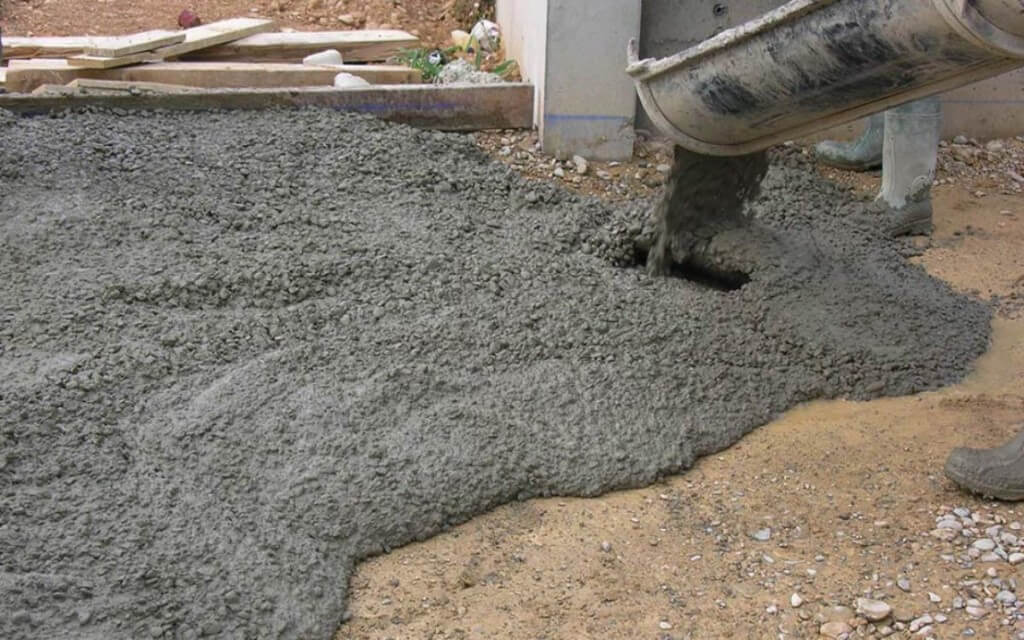
What is concrete?
The RAE defines concrete as follows:
A material resulting from mixing water, sand, gravel and cement or lime, which gains strength as it sets.
What is concrete made of?
Concrete consists of the following ingredients:
- Binder (hydraulic cement): 10-15%
- Synthetic granules: 65-75%
- Fine aggregate (sand)
- Coarse aggregate (gravel or stone)
- Water: 15-20%
- Entrapped air: 1-2%
- Additions and admixtures (occasional): variable %
Sand is one of the aggregates with the greatest influence on the characteristics of concrete. In fact, the best sands are those washed with fresh water. Coarse aggregates (for example, gravel or stone) also give the cement greater density.
Generally, these account for 60 to 75% of its total volume. The type and size of aggregate used vary depending on the thickness and purpose of the final concrete product.
Excessive impurities in the water can affect the setting time and strength of concrete, as well as cause efflorescence, staining, reinforcement corrosion, volume instability or reduced durability, among other problems. For this reason, the water must be treated to remove these impurities before it is used to prepare concrete.
How do you make concrete?
Making concrete is not much more complicated than making a cement mix, as you simply need to add one more ingredient: gravel. However, the proportions must be taken into account to achieve a good mix.
To make concrete, mix equal quantities of water and cement, and add three times as much sand, along with the gravel. The proportions may vary depending on the intended use of the concrete.
- 1 part cement.
- 1 part water.
- 3 parts sand.
- 4 parts gravel.
If you decide to add more water, the concrete will be easier to work with but its strength will be lower. First mix the dry materials, then add the water gradually.
Properties of concrete
The properties of concrete vary depending on its state, which may be fresh (it can be worked) or hardened (it cannot be worked because of its rigidity):
Fresh concrete
When concrete is first mixed, it is like bread dough: soft and easy to work or mould. Its most important properties include:
- Consistency: the ease with which concrete deforms. It is directly related to workability and is considerably affected by the amount of water relative to the mass.
- Workability: indicates how easily concrete can be transported and placed without losing its consistency. The amount of water and the size of the aggregates have a significant influence.
- Homogeneity: indicates how the components of the mix are distributed throughout its mass. To maintain the correct proportions throughout, thorough mixing and careful transport and pouring are necessary, preventing the aggregates from segregating or settling.
- Density (kg/m3): or specific weight, measures the amount of mass relative to the volume it occupies.
Hardened concrete
Concrete reaches this state when it has begun to gain strength and is approaching the end of setting (loss of water and air). The properties to consider are:
- Density: we have already discussed this above.
- Permeability: the ability of water to penetrate (through capillary action or pressure) without altering the internal structure of the concrete.
- Compactability: indicates the maximum density the mix can achieve. The greater this is, the better protected the concrete will be and therefore the more durable.
- Strength: its ability to withstand compression, tension and wear.
What are the types of concrete according to their characteristics?
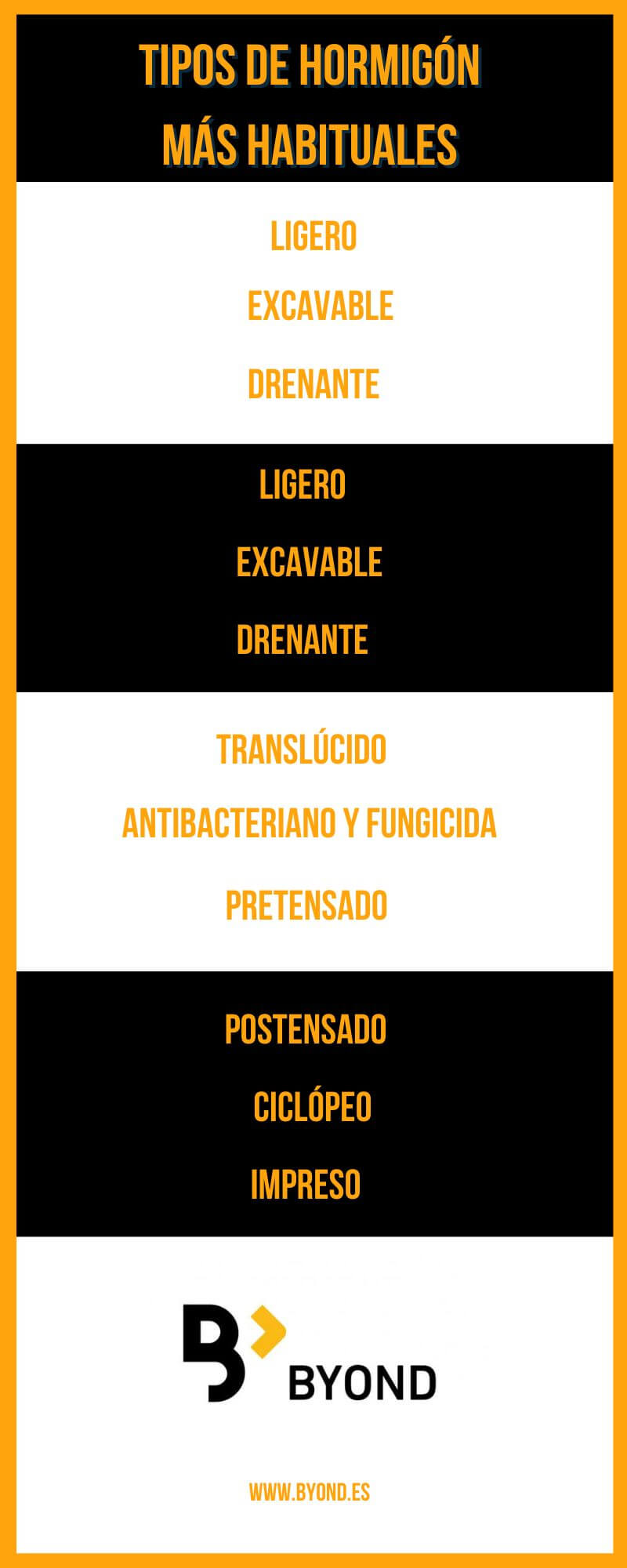
Below we look at the types of concrete available on the market and used to meet specific requirements:
1. Self-compacting concrete
One interesting type is self-compacting concrete, which should not be confused with flowing concrete, as their properties differ.
Self-compacting concrete is obtained by mixing in resins or superplasticising admixtures, resulting in self-compaction. This is beneficial because the concrete does not require constant attention.
2. Fibre-reinforced sprayed concrete
Reinforcing concrete with different fibres produces a much more robust result. One advantage of using fibres instead of structural reinforcement is that they do not suffer from corrosion. There are several types of fibres, each used for a specific purpose.
3. High-strength concrete
High-strength concrete is among the types of concrete most widely used in large structures or skyscrapers. It is also used in civil engineering, although it has yet to gain traction in the building sector despite its considerable advantages.
4. Lightweight concrete
Lightweight concrete contains a component that reduces its weight, such as expanded polyethylene, expanded clay or vermiculite… It should not be confused with cellular concrete.
5. Excavatable concrete
This type of concrete is ideal for filling holes or trenches and can replace fill made from graded aggregate.
6. Pervious concrete
This concrete is interesting for its ability to provide a firm yet highly porous surface, allowing water to pass through it to the layers below.
7. Translucent concrete
This is perhaps one of the most interesting and innovative types. It is concrete mixed with millions of optical cable fibres, allowing light to pass from one side to the other. Thanks to its strength, this concrete is ideal for creating decorative features or more complex structures.
8. Antibacterial and fungicidal concrete
Antibacterial concrete is a new form of concrete; one way to describe it is as a version of hygienic concrete.
However, it is not made using a liquid that impregnates its surface, but rather a material incorporated during concrete production that prevents microorganisms from developing on its surface.
It is quite interesting: the raw material is traditional concrete, but enriched with special admixtures that give it its antibacterial property. This type of antibacterial concrete is used in the food industry, health centres and clinics, slaughterhouses, and chicken and pig farms.
By inhibiting bacterial growth on the concrete surface, it acts as an effective repellent against microbes and germs that cause intestinal and respiratory conditions and, generally, viral illnesses.
9. Pre-tensioned concrete
The tensile strength of traditional concrete is lower than its compressive strength.
With this in mind, if we wish to use concrete in structural elements that withstand tension under service loads, this lack of tensile strength must be compensated for.
In pre-tensioned concrete, the cable is not sheathed but left exposed within the concrete so that, through friction or adhesion between the cable and the concrete, it transmits compressive stress to the concrete after it has gained its initial strength.
This procedure creates an excellent bond between the steel and the concrete, which protects the bars from oxidation and allows direct stress transfer.
The concrete bonds to the bars, and when the tension is released, it is transferred to the concrete as compression through friction. However, strong external anchorage points are required to stretch the steel bars in a straight line.
Most pre-tensioned elements are therefore precast in a laboratory and must be transported to the construction site. Pre-tensioned elements may include piles, balcony elements, floor slabs, double-T beams for covering large spans in car parks and buildings, etc.
Thanks to their high capacity, pre-tensioned structures can be used for large spans and high imposed loads. Another major advantage is that cracks and fissures are controlled.
10. Post-tensioned concrete
Post-tensioned concrete is concrete subjected, after pouring and setting, to tensile stresses by means of steel cables installed inside sheaths or pipes that encase them, so as not to transmit compressive stresses to the concrete.
This is the difference between pre-tensioned and post-tensioned concrete. The stresses are transmitted to the supports, making it possible to cover a greater span from one support to another. We can see this mainly in bridges and long-span structures.
Curing this type of concrete is extremely important at the production yard, as both the initial strength it gains and crack control will depend partly on this.
11. Cyclopean concrete
This type of concrete is made by adding local stones during concreting to save material. It contains stones larger than 30 cm.
It is used where excavations need to be deepened below the designed level to achieve a supporting foundation that meets the requirements of the structures.
12. Pattern-imprinted concrete
Pattern-imprinted concrete surfacing is a decorative technique that allows textures, reliefs, patterns and shapes to be applied. Its applications therefore promote strength and the creation of attractive designs.
Now that you know all about the types of concrete available on the market, the big question is: which best suits your needs? If you do not know the answer, do not hesitate to contact Byond for advice on these and other alternatives, without obligation.