
To do so, they must be able to find their way and avoid obstacles and risks of all kinds, particularly those arising from vehicle traffic, unmarked or unprotected changes in level or openings, and projections or objects that encroach on the walking route at a height that cannot be detected by the canes they normally use.
To detect and avoid these barriers and hazards, they use various techniques and strategies that allow them to move around the city independently. They therefore make the most of perceptible information, especially through hearing, light contrasts where possible, and the combination of touch and limb movement with the use of canes.
This is where tactile paving comes into play.
What is tactile paving?
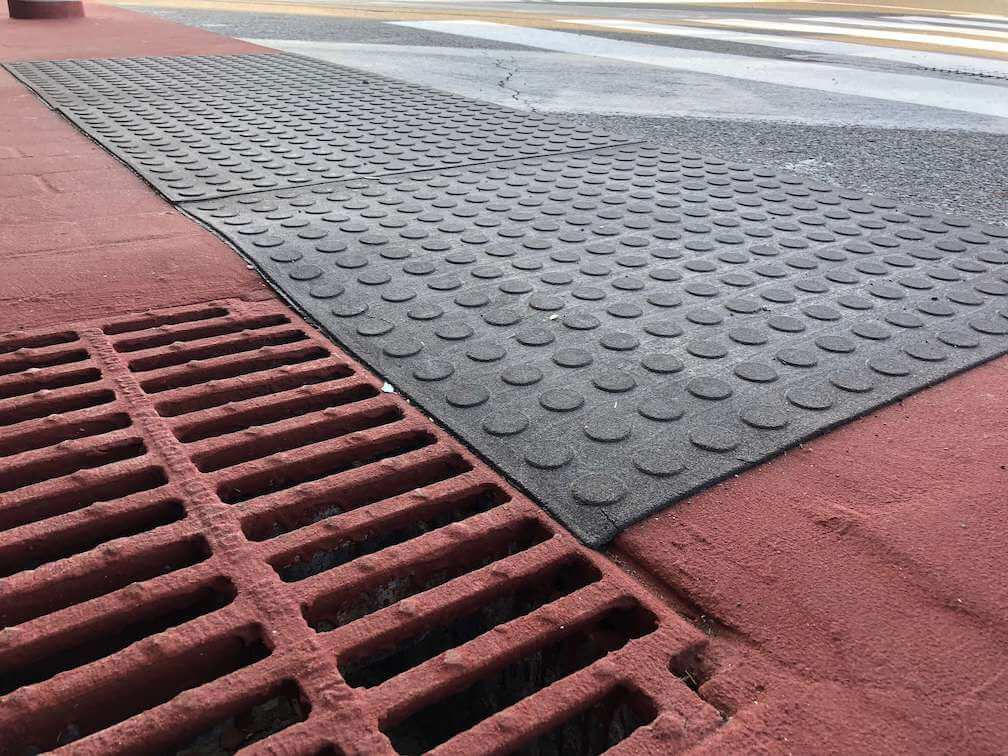
Tactile paving is a surface made up of tiles with a tactile texture. These directional indicators serve to guide and warn blind or partially sighted people when they walk or try to cross a street.
This tactile guidance paving can be used to facilitate access to busy public places such as shopping centres, hospitals, schools, hotels, public spaces and car parks, among others.
It should also be noted that indicator paving helps not only blind people to find their way, but also people with cognitive disabilities, children and older people.
What types of tactile paving are available?
There are different types of paving with tactile features that serve different purposes.
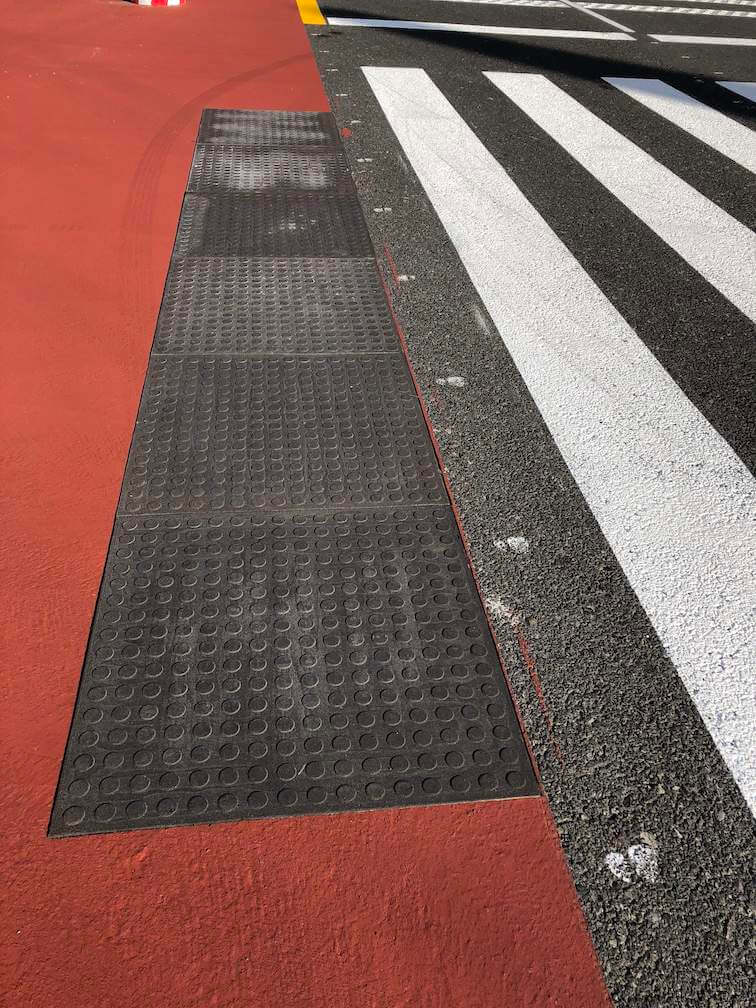
Tactile warning paving indicating hazards or proximity to danger points
Made up of raised studs. Its main uses are as follows:
- Decision points along guidance routes.
- Dropped kerbs at pedestrian crossings.
- Metro, tram, commuter, medium-distance and long-distance train platforms.
- Bus stops with or without shelters, on both urban and interurban routes.
Directional tactile indicator paving
Formed by straight, parallel grooves. It is mainly used to:
- Warn of crossing points between pedestrian routes and vehicle traffic.
- Create guidance routes.
- Connect two building lines.
- Mark the location of public transport features in the urban environment.
- Indicate features involving changes in level along accessible routes.
Tactile guidance paving regulations
The geometry of guidance paving for blind people is set out in standard UNE-CEN/TS 15209:2009 EX (Tactile paving surface indicators produced from concrete, clay and natural stone).
For use in Spain, the two indicators are studs and longitudinal strips. They must also be manufactured in accordance with the following standards:
- UNE-EN 1339:2004 (Concrete paving flags. Requirements and test methods).
- UNE-EN 1338:2004 (Concrete paving blocks. Requirements and test methods).
Compliance is also required with Order VIV/561/2010 of 1 February, which develops the technical document on basic accessibility and non-discrimination conditions for access to and use of developed public spaces.
What is the best tactile paving on the market?
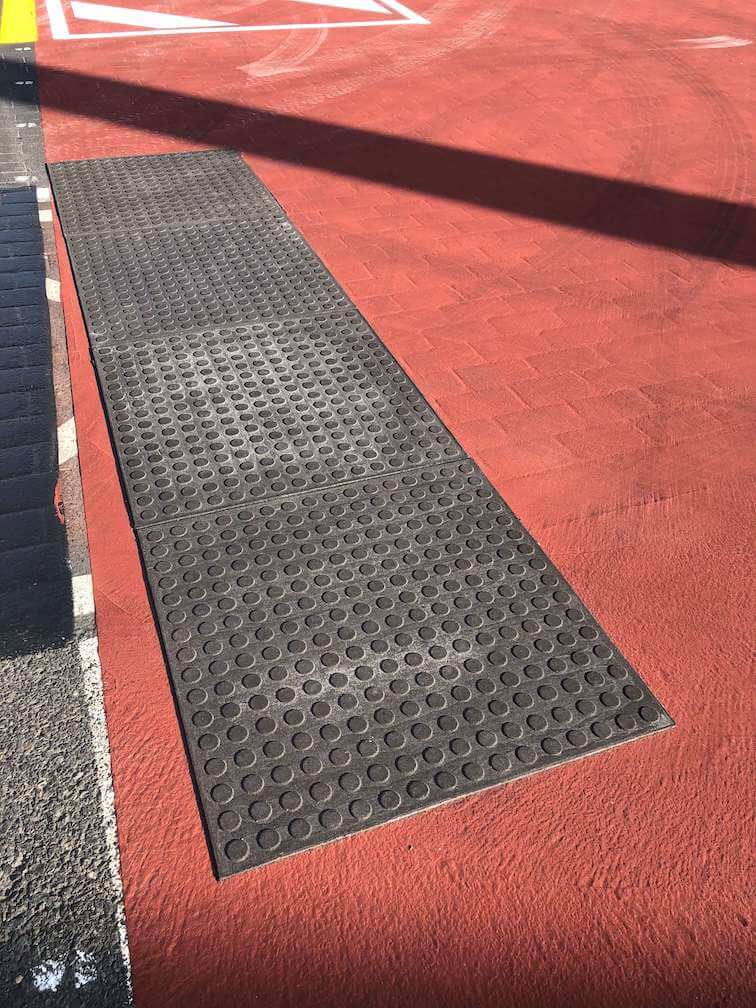
At Byond, we have created Zoruflex® Podotáctil Autoadhesivo, an indicator paving system meeting the highest quality standards, with advantages including the following:
- The same system as self-adhesive tiles.
- Very long-lasting durability.
- Exceeds slip-resistance requirements.
- Withstands vehicle traffic.
- Customisable to suit the character of the area.
- Decorative.
- Adaptable to uneven surfaces.
- Applied directly to different substrates (asphalt, metal, wood…).
- No building work or maintenance required.
This tactile warning system features raised profiles with a maximum height of 5 mm, in two types:
- Warning system: with circles that provide warnings in places where there may be a risk, such as changes of direction or road crossings.
- Guidance system: with straight, parallel lines. Its guidance strip can run transversely (to warn of the presence of a relevant feature) or in the direction of travel (to help locate features such as changes in level).
Both types are produced in different sizes:
- 300 x 300 x 5 mm
- 400 x 400 x 5 mm
- 800 x 800 x 5 mm
How is tactile paving installed?
Before installation begins, a preliminary study must be carried out to analyse the accessibility needs of the specific space and the type of surface on which the installation is to be carried out. Once measurements have been taken, an application plan is drawn up using the appropriate products.
A preliminary treatment is then applied to prepare the surface and, finally, the professional team installs the system quickly and without building work, leaving it ready to walk on within a few hours. It is a clean process that does not obstruct pedestrian traffic or require areas to be closed for long periods.
At Byond, we are experts in supplying and installing tactile, underfoot tactile and tactile-visual paving, as well as directional indicators and indicators warning of hazards or proximity to danger points, along accessible pedestrian routes. Do not hesitate to contact us to create a more accessible environment!