What is cement?
The RAE defines cement as follows:
A construction material consisting of a powdered substance which, when mixed with water or another substance, forms a soft paste that hardens in contact with water or air; it is used to plug or fill gaps and as a binding component in concrete blocks and mortars.
What is cement made of?
The basic composition of cement varies according to its type. For example, the composition of Portland cement (the most widely used and best known) is as follows:
- Silica: 19-25%
- Alumina: 3,5-8%
- Iron oxide: 2,5-4,5%
- Lime: 62-65%
- Gypsum: 1,5-4,5%
- Magnesia: 0,5-5%
- Alkalis: 0,2-1,2%
How is cement manufactured?
The basic cement manufacturing process is as follows:
- Extraction, crushing, proportioning, adjustment and grinding of the raw materials (limestone, clay, sand, gypsum, iron ore, etc.).
- The raw materials are homogenised in storage tanks to produce basic units called clinker (products in the form of granules or small balls measuring between 0,5 and 25 mm, formed by calcining the raw materials at temperatures ranging between 1350 ºC and 1450 ºC).
- Cooling and storage of the clinker.
- Addition of gypsum to reduce the basic material's tendency to shrink excessively as it sets.
Properties of cement
The main physicochemical properties of cement are as follows:
- Fineness: the contact surface area is vital, since the finer the cement particles, the faster the hydration rate. This results in faster strength development in the concrete.
- Setting time: when cement reacts with water and forms the concrete paste, it creates a mixture that remains plastic for a limited time and gradually hardens.
- Normal consistency: the fluidity of the mixture for a given quantity of water is related to the quality of the cement and its setting time.
- Mechanical strength: cement gives concrete mechanical strength. However, the quality and proportions of the other components also influence its strength, albeit to a lesser extent.
- Heat of hydration: hydration is a reaction that releases heat. This makes it possible to determine the maximum temperature the fresh concrete will develop, as well as when it will be reached.
What are the differences between cement and mortar?
Essential for laying floors, foundations and structural floor slabs, mortar and cement are also needed for any type of construction work.
Cement, on the one hand, is one of the components used to make mortars and concrete. Its main characteristic is that it gradually hardens on contact with water, reaching its maximum hardness several weeks after mixing.
This type of setting makes it the ideal binder for producing mortars and concrete used in construction, where rapid dehydration of materials can cause problems such as cracks or breakages.
Mortar, on the other hand, is a mixture of cement or lime (or both), sand and water in varying proportions depending on the desired result or the type of work to be carried out. Different additives can be added to this mixture to strengthen or improve a particular property (elasticity, watertightness, strength...).
It is used as a bonding material for bricks or concrete or stone blocks to build walls; it is also used to level interior and exterior walls, even if they will not receive another final finish; to lay ground-bearing slabs and level ground, or to point, seal, harden and reinforce construction materials and elements.
It is also used as a final finish for exterior walls and façades, particularly lime and water-repellent mortars, which allow the wall to breathe while preventing water penetration.

What are the types of cement according to their characteristics?
Below, we look at the cements available on the market and used according to specific requirements.
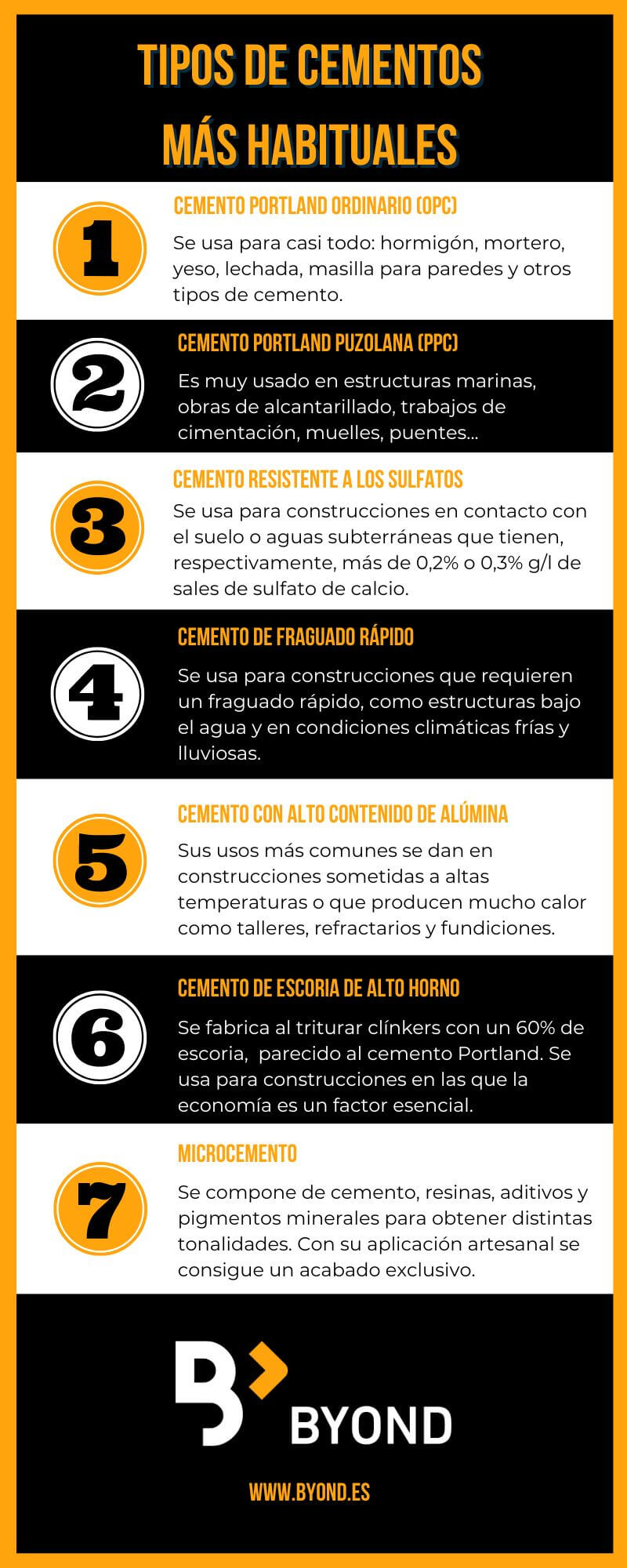
1. Ordinary Portland Cement (OPC)
Also known as OPC, ordinary Portland cement is manufactured and used worldwide for all purposes. It is widely used for all applications, including:
- Concrete: widely used in building construction.
- Mortar: for bonding masonry.
- Plaster: to give walls a perfect finish.
It is also used to make grout, wall putty and different types of cement.
2. Portland Pozzolana Cement (PPC)
To prepare PPC, or Portland Pozzolana Cement, pozzolanic clinker must be ground with Portland cement. PPC is widely used in marine structures, sewerage works, foundation works, docks, bridges...
3. Sulphate-resistant cement
This cement is manufactured to resist sulphate attack on concrete. Sulphate-resistant cement is used for structures in contact with soil or groundwater containing, respectively, more than 0,2% or 0,3% g/l of calcium sulphate salts.
4. Quick-setting cement
This type of material is used for construction requiring rapid setting, such as underwater structures and construction in cold and rainy weather conditions.
5. High-alumina cement
High-alumina cement is obtained by calcining bauxite and lime with clinker during the OPC manufacturing process. Its most common uses are in structures exposed to high temperatures or that generate a great deal of heat, such as workshops, refractory structures and foundries.
6. Blast-furnace slag cement
This type of material is manufactured by grinding clinker with around 60% slag and is similar to Portland cement. It is used for construction where economy is an essential factor.
7. Microcement
Microcement is a material composed of cement, resins, additives and mineral pigments that can produce different shades. Its handcrafted application creates an exclusive finish, meaning that no two surfaces are alike.
Now that you know everything about the types of cement available on the market, the big question is: which one best suits your requirements? If you do not know the answer, do not hesitate to contact Byond for advice on these and other alternatives, with no obligation.