
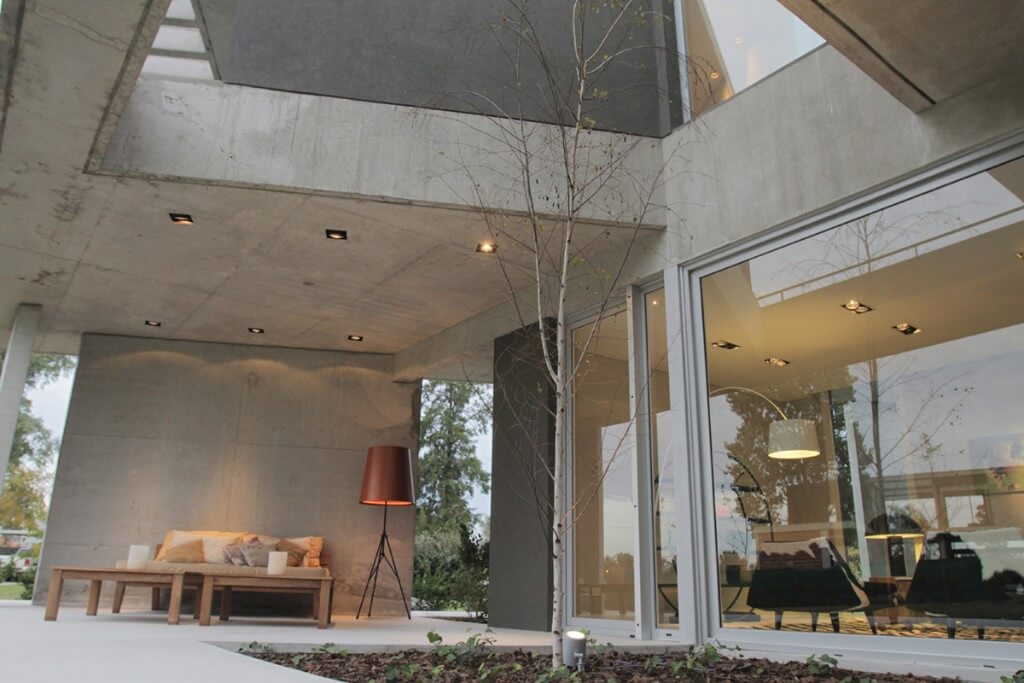
Architects around the world are fascinated by the finishes offered by this type of concrete. However, it offers multiple uses, advantages and possibilities, which we will examine below.
What is exposed concrete?
In short, exposed concrete is a mixture of gravel, cement, aggregates and water whose finish is that of the material itself.
It is a construction material that serves both as an enclosure and as a structural element. Its level of quality varies depending on its formwork, as it must visually suit the needs of each project.
Its cost, results and characteristics make it a commonly used material in construction. Exposed concrete is very inexpensive compared with other types of materials, allowing the construction budget for homes, for example, to be reduced.
It is a material with striking decorative possibilities, offering numerous options in terms of colour and texture.
How to recognise exposed concrete
This new trend aims to reveal the material from which a structure is built, offering a visual finish whose final appearance will vary according to the type of formwork. As it is placed, the concrete acquires its texture, hardening and taking on the surface characteristics of the formwork.
Types of formwork for exposed concrete
The choice of formwork depends on aspects previously analysed during the project design, such as the pressure exerted by the concrete or the weight of the structure.
Below, we will look at the types of formwork most commonly used for exposed concrete, depending on sustainability and aesthetic requirements.
Metal formwork
For large-scale construction projects, this is the most advisable type of formwork. Its advantages are as follows:
- It provides very smooth finishes.
- It is quick and easy to assemble and dismantle.
- It is strong.
As we can see, these qualities increase productivity in the construction process. It is a sustainable and safe choice if the planning work has been carried out correctly.
Timber formwork
If you need formwork that is economical and easy to handle, timber formwork is the best option. It is also perfect for small jobs.
It is vital to consider that imperfections in natural timber will affect the final result. These are details that must not be overlooked.
If plywood panels are used, they are easier to fit and have a flatter, more uniform finish than natural timber.
However, the main drawback is recycling. Although it can be reused, there is a limit, generally between three and four times.
Interestingly, there is even formwork made from bamboo.
Advantages of exposed concrete
The main benefits of exposed concrete are as follows:
- Colour: finishes in different colours, either using the colour of the matrix or adding pigments or colourants.
- Thermal conductor: ideal for flooring.
- Hardness and durability: these make it the material of choice for many structures.
- Economical: thanks to its constituent materials: cement, gravel, aggregates and water.
- Easy to install: savings in labour and time.
- Fireproof: it is not a good conductor, making it safe in the event of fire.
- Mouldable: it can take different shapes without losing its strength.
- Low maintenance: easy to clean, with water and a cleaning product being sufficient, and it does not deteriorate.
Why exposed concrete is so widely used
Exposed concrete has become a growing trend for the following reasons:
- It is highly adaptable and offers many possibilities.
- It withstands changes in climatic conditions and remains intact over time.
- It adds functionality and gives the building character, design and prominence.
Uses of exposed concrete
It should not be forgotten that, for concrete intended to remain exposed, installation by true professionals is recommended, following meticulous technical criteria to prevent variations in shape and colour and ensure the highest quality.
This technique is widely used in all types of industrial buildings, commercial premises and car parks. It can also be seen in outdoor and indoor areas, used for stairs, walls, ceilings or flooring.
Although it may seem unusual, it is widely used in residential interiors, particularly in luxury minimalist homes, as interior designers use it for the numerous aesthetic options it offers without excessive ornamentation.
Indeed, exposed concrete embraces minimalist decoration, in which simplicity takes precedence.
Other places where architectural concrete can be used include the following:
- Toilets
- Fireplaces
- Kitchens
- Stadiums
- Museums
- Corridors
- Columns
- Concert halls
- Communal areas
It works really well with wood, whether used in furniture, walls or flooring.
What to consider when maintaining exposed concrete structures
To ensure that exposed concrete is properly preserved, a number of aspects must be considered:
- Climate: despite its high resistance, it is essential to assess the type of climate where the concrete structure will be installed.
- Waterproofing products: water ingress and fungal growth are the true nemeses of exposed concrete. Using waterproofing products reduces their occurrence.
- Materials: before construction begins, materials must be selected and cared for meticulously.
- Do not leave components exposed to the outdoors: the structure must be as airtight and well sealed as possible.
The more thoroughly these factors are addressed, the lower the likelihood of damage.
How to achieve perfect results with exposed concrete
To achieve perfect results, the following aspects must be considered:
- Execution must be perfect, as the work requires meticulous attention to every detail to achieve a unique finish.
- Choosing the right formwork for the situation is essential.
- Appropriate materials must be selected according to the project.
Conclusions
Today, it is time to leave behind the traditional view of concrete: its decorative uses are perfect for almost any location.
In fact, exposed concrete combines every characteristic and benefit inherent to this material, as it contains exactly the same ingredients and is used in its natural state, without undergoing any process that alters it.
Sometimes, depending on the type of formwork used, you may not be able to tell them apart, but in reality they are easily recognised. In addition to timber and metal formwork, there are also types made from plastic and other materials.
However, it must not be forgotten that if you really want it to look attractive, you need to contact professionals.
Do not hesitate to contact Byond for advice on exposed concrete, with no obligation.