
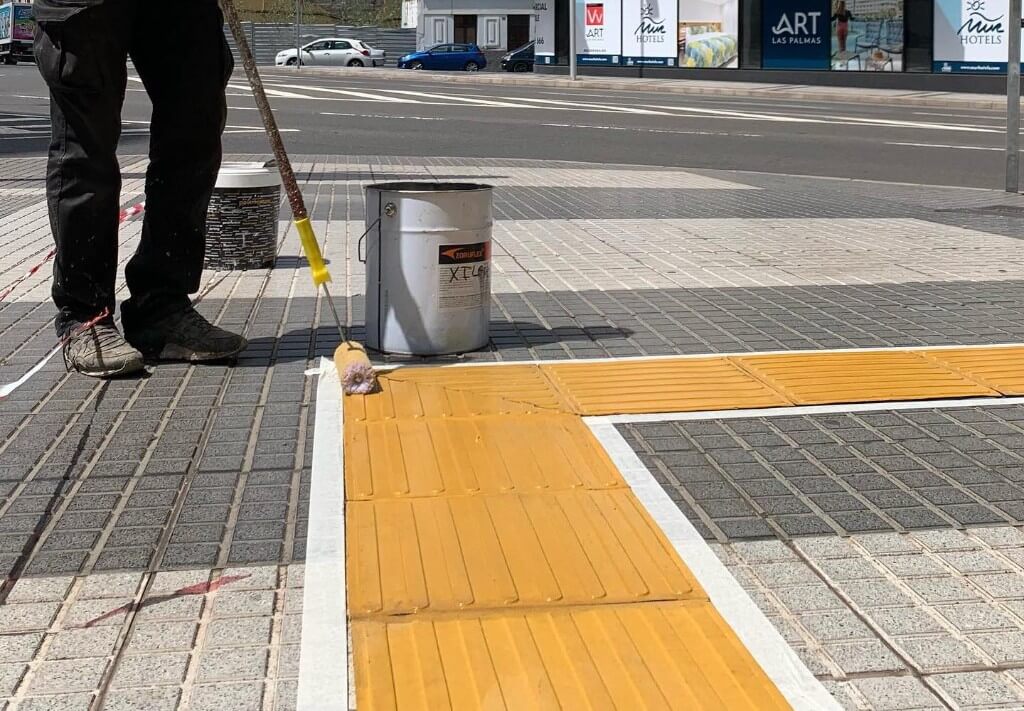
Indeed, we live in a society in which a picture is worth a thousand words and in which orientation and communication tools are developed around one fundamental sense: sight.
However, for blind and partially sighted people, both these advances and the undeniable predominance of visual information can create new barriers and factors of exclusion that prevent their full participation and integration in the community.
Of course, as citizens and consumers of goods and services, they have the full right to access every location and the information provided independently.
Ensuring that everyone can use and enjoy their surroundings safely, comfortably and independently is a challenge for us all. One of the steps we take in this direction at Byond is to manufacture accessible surfacing.
In fact, one of our priorities is to use this type of surfacing to help make environments, goods and services fully accessible to people with visual impairments.
Tactile surfacing to improve accessibility for people with visual impairments
As with other elements addressed in an accessibility study, compliance with existing regulations is essential for accessible surfacing. However, this alone does not ensure its successful implementation.
It is essential to apply logic and sound judgement to ensure that pedestrians with reduced mobility can move around properly, putting yourself in the position of those who will walk on and use the tactile surfacing to assess whether it guides them safely and independently.
Benefits of accessible surfacing for blind and partially sighted people
Sight allows us to interpret our surroundings and develop motor behaviours that enable us to organise and control space, which is essential for reaching a specific location, moving around a building and carrying out all kinds of activities independently.
People with visual impairments have to replace or complement these abilities with specific perceptual skills supported by greater use of their other senses.
To facilitate independent navigation, it is vital for environments to have tactile surfacing to:
- Compensate for limitations in perceiving purely visual content.
- Make it easier to locate points of interest, objects...
- Minimise hazards and warn of potential risks.
- Enable orientation within spaces.
- Receive the available information in an understandable form in order to carry out actions, make decisions...
Installing these types of textures allows people with limited or no sight to identify or distinguish between different spaces, establish where they are and assess the terrain and surfaces they move across, enabling them to deal successfully with most of the situations they face in their daily lives.
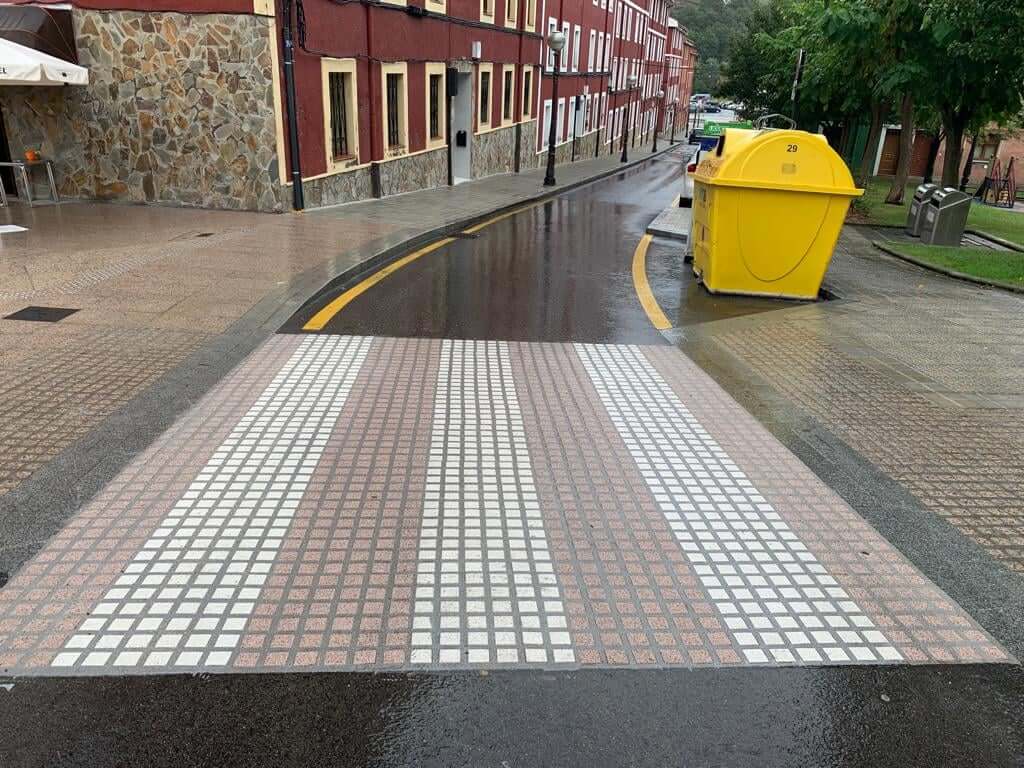
Regulations on tactile surfacing for people with sight difficulties
The various regulations, technical documents and manuals on tactile surfacing cover important aspects such as the following:
- Surfaces must be slip-resistant and easy to detect.
- The routes pedestrians will follow must be accessible, providing guidance and warnings about elements in their path.
- Transverse strips will be installed on ramps or stairs to guide the way on both sides. Directional guidance strips will also be placed transversely in front of lift doors.
- Strips 0.60 m deep will be installed between pedestrian routes and vehicle routes.
- If roadworks or other work along the route obstruct passage, temporary directional guidance surfacing must be installed to guide people along an alternative route.
- Pedestrian crossings or key points along pedestrian routes must be marked with tactile surfacing.
How to obtain the best accessible surfacing on the market
Be sure to contact the team of professionals at Byond for advice on our tactile surfacing at different stages:
- Assessment and advice
- We design the project using the most appropriate accessibility techniques and products.
- We analyse the accessibility and safety needs of the space or building.
- We study the characteristics of the surfaces and take measurements.
- We develop a tactile surfacing installation project using the techniques and products best suited to each environment.
- Surface preparation
- We carry out a preliminary treatment that preserves the original surface.
- We prepare and level the surface.
- We repair imperfections, holes and cracks.
- We apply cleaning and degreasing products, blast, sand and polish surfaces to ensure optimal application of the tactile surfacing, preserving and even improving their natural strength and relief.
- Tailored installation
- Our team of professionals carries out installation quickly, without building work or closing off spaces.
As you will have seen, people with sight difficulties must be able to move along public streets independently and without obstacles.
For this reason, accessible surfacing is the best way to guide blind and partially sighted people along their routes through public places.