
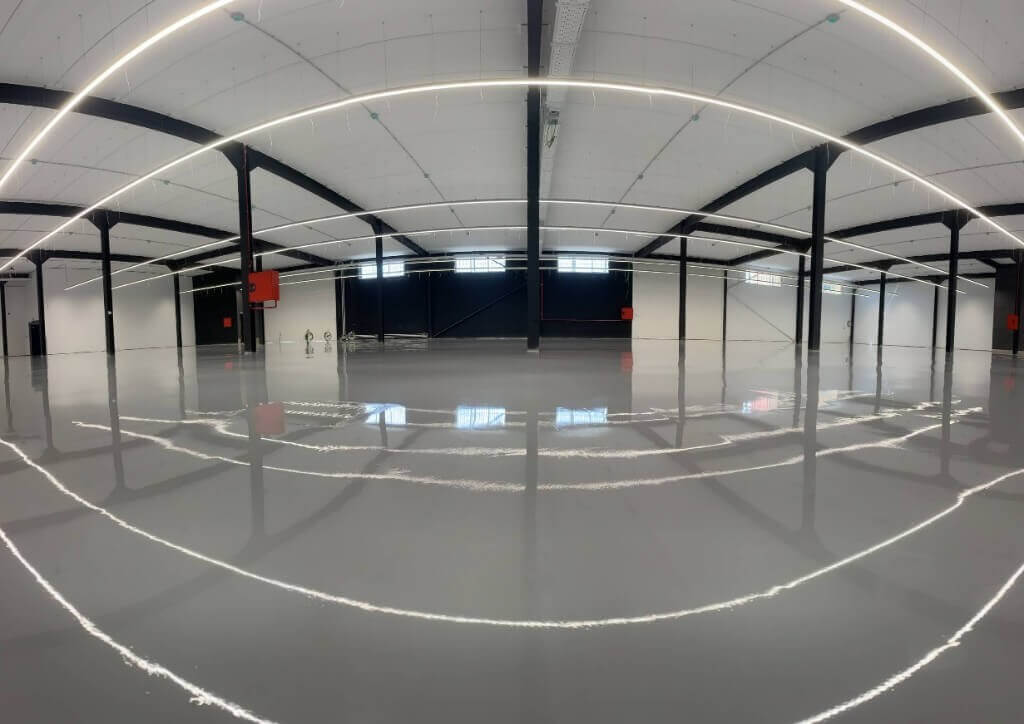
Although it has predominantly been used in industrial and commercial areas, its use in private homes and offices is gradually increasing, thanks above all to its attractive integration, finishes and colours.
For all these reasons, this new article will explore everything about this coating in depth, from its main characteristics to its advantages, along with various recommendations and much more.
What is epoxy resin flooring?
Epoxy resin is a material that can be used to create seamless flooring with widely differing finishes. It is a flooring material –also known as a seamless polymeric coating– whose defining features are durability, gloss and superior chemical resistance compared with other existing coatings.
Indeed, flooring of this type consists of a thermosetting polymer that reacts and hardens when mixed with a catalyst. This composition is responsible for durability, impermeability and abrasion resistance being among its main characteristics.
Furthermore, it is a flooring material that does not deform in heat and stands out from other coatings for its greater hardness, as well as offering a slip-resistant finish.
5 advantages of epoxy resin flooring
This flooring offers the following benefits:
1. Solvent-free
Many of the materials used for flooring include components containing solvents, which give off strong odours. This does not happen with epoxy resin, since its formula contains no solvents, making installation more comfortable.
2. Short drying time
This flooring offers a short drying time compared with other options on the market, as it usually takes around 8 hours to dry. This means the flooring system can be walked on just 24 hours after application.
3. Seamless, smooth finish
Since this coating is very thin, seamless, smooth finishes can be created easily. This property allows spaces to appear larger, particularly smaller spaces.
4. Application over existing flooring
This system allows any space to be revitalised without removing the existing flooring. Furthermore, since no building work is required and no rubble is generated, renovation takes less time than with other coatings.
5. Greater resistance than other flooring
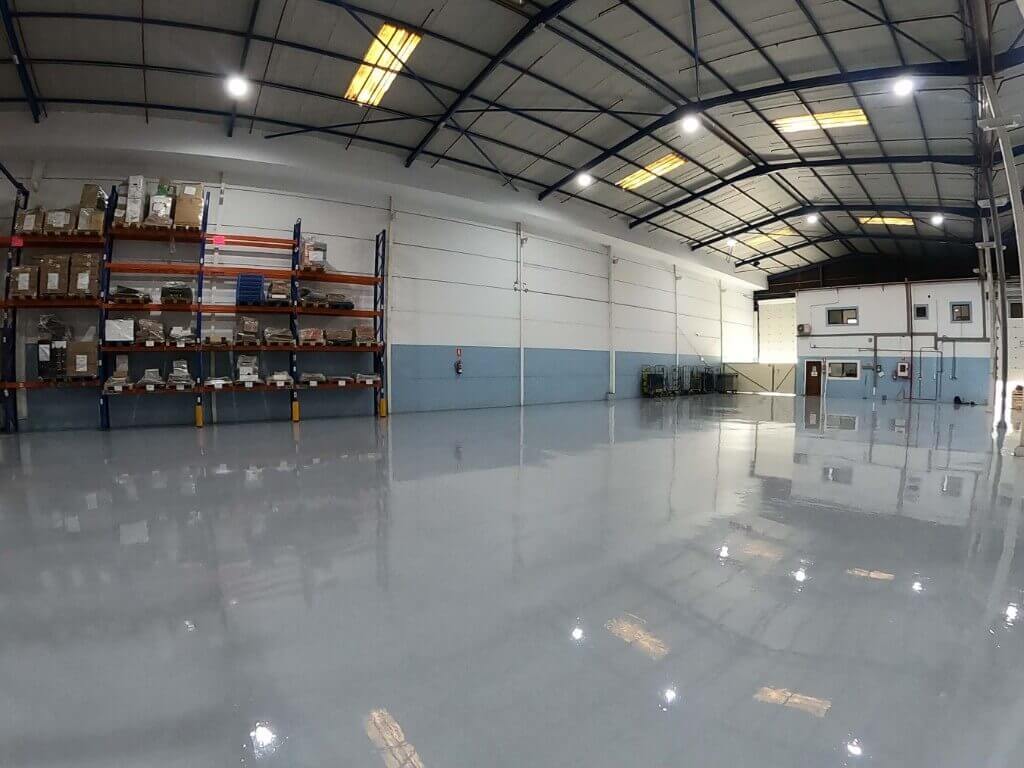
This coating offers high resistance to corrosion, abrasive wear and traffic without suffering damage. This ability to withstand demanding conditions makes it suitable for areas where vehicles and heavy machinery are parked, laboratories and warehouses, among others. Likewise, epoxy flooring can be exposed to chemicals for a long time without any loss of performance.
Types of epoxy resin flooring
The wide variety of finishes available for this flooring is more than evident:
1. Epoxy paints
These are brightly coloured floor coatings applied in car parks and industrial buildings. They stand out for their average thickness of 0.2 to 0.4 mm, their inclusion of a primer and their high resistance to forklift and vehicle traffic.
2. Epoxy microcement
Epoxy microcement is a highly functional seamless decorative coating, thanks to its excellent performance and incredible decorative finishes.
3. 3D, vinyl or artistic epoxy resin flooring
This epoxy resin flooring is created by pouring transparent self-levelling epoxy over a vinyl graphic. The result is a glass effect and a fixed image in the flooring, which is completely protected by a layer of glass-like epoxy.
4. Epoxy resin flooring with multilayer systems
Multilayer systems are epoxy resin coatings with slip-resistant finishes and an average thickness of 2 mm per fully broadcast layer. Coloured quartz aggregates are used for decorative finishes.
They consist of alternating layers of primer and epoxy paint, into which aggregates are scattered (known as aggregate broadcasting) to create rough, slip-resistant surfaces. If coloured quartz aggregates and transparent resins are used, the resulting decorative flooring will be of high quality.
5. Self-levelling epoxy resin flooring
This is the best-known type and is mainly used as flooring in industrial areas because of its excellent mechanical and chemical performance. Its finishes are generally coloured. There are two subtypes, depending on thickness:
- 1 mm: with smooth, glossy finishes, these are normally applied to concrete in good condition, self-levelling mortars or similar substrates to ensure superior protection.
- Over 2 mm: the most widely used in decoration, these are ideal for uneven surfaces or smooth surfaces that need greater durability.
Where can epoxy resin flooring be installed?
Epoxy flooring can be installed on practically any surface thanks to its low thickness and quick maintenance. Even so, there are places where it is used more frequently, such as the following:
- The attractive appearance of epoxy flooring makes it ideal for offices, commercial premises and homes.
- Thanks to the clean, aseptic appearance of this flooring, its use has increased in automotive workshops, car parks and garages, as well as factories and warehouses.
- It is highly regarded for its chemical protection and is applied in food businesses exposed daily to spills of fruit juice, lactic acid, blood... It also protects against spills of aggressive liquids, making it ideal for laboratories and warehouses.
- Due to hygiene requirements, this flooring is highly valued in food businesses and kitchens. It is also very common in pharmaceutical laboratories and hospital wards.
Epoxy resin flooring price: how much it costs per m2
The price of epoxy flooring varies depending on the system chosen. As such, coating a floor with epoxy paint is considerably cheaper than installing 3D or vinyl flooring.
While the former costs around 8-10€ per square metre, the latter can reach a minimum of 100€.
In any case, the price per square metre of epoxy resin flooring depends on the following aspects:
- The tools used.
- The size of the space.
- Whether the substrate requires repair beforehand.
- The quality of the material and the system selected.
Why use epoxy resin on a wooden floor
This groundbreaking decorative finish is one of the great allies of wooden flooring for the following reasons:
- It protects and waterproofs wooden flooring, preventing woodworm and damp.
- Wooden flooring can be laminated, varnished and encapsulated. Any creation and finish is possible.
- It gives the wood a shine, creating a glass-like appearance on the floor.
5 reasons to use epoxy resin flooring in the home
The main reasons to use epoxy flooring in a home are as follows:
1. Innovative appearance
Its versatility allows all kinds of adaptable designs and patterns to be created on the flooring, as well as offering a choice of many colours and textures.
2. Convenience all round
Since epoxy flooring is compatible with all types of surfaces and does not require heavy machinery, its application is truly practical.
3. 100% impermeability
Epoxy flooring does not cause damp problems, so products such as varnishes or sealers are not necessary. This makes it ideal for bathrooms and kitchens.
4. Slip-resistant
As a slip-resistant material, it is ideal for high-traffic areas such as stairs, kitchens and bathrooms.
5. Minimal cleaning and maintenance
Cleaning requires only a damp cloth, water and mild detergent. Furthermore, as there are no joints, bacteria, fungi and mould do not proliferate.
Epoxy resin surfacing outdoors
Yellowing is one of the main problems with using this type of surfacing outdoors, as it is sensitive to sunlight and adverse weather conditions. For this reason, outdoor use is not very common.
However, with the correct treatment, it can be used outdoors. To do so, it must be sealed with at least one coat of aliphatic polyurethane. This will produce higher-quality surfacing with greater abrasion resistance.
Conclusion
Epoxy flooring is gaining ground every day thanks to its significant advantages over other types of flooring, as it is perfect for renovating any floor surface without costly renovation work.
Do not hesitate to contact Byond for advice on the subject from the Canary Islands' leading experts in epoxy resin flooring. Visit our catalogue of services to see all our projects first-hand.