
So, at Byond, as specialists in the maintenance, refurbishment and improvement of industrial flooring, we want to clear up some questions about “dianovado”, a floor preparation process, and help you understand what it is and where this new word comes from.
What is industrial floor preparation known as “dianovado”?
First things first. Neither “dianovado” nor its verb form “dianovar” is recognised in the dictionary of the Real Academia Española (RAE).
Be that as it may, the fact is that the RAE often does not keep pace with everyday speech. And this is a good example.
A search through specialist flooring websites reveals that these words refer to all the substrate preparation carried out before applying a resin-type coating.
As such, these terms may refer to:
- Substrate preparation.
- Substrate levelling.
- Floor grinding.
However, more specifically, and in our experience, these words refer to two others used in our sector: “diamantar” (diamond grinding) and “renovar” (refurbishment):
- Diamond grinding refers to the material used to sand and polish floors, or to the technique of grinding floors with diamond tools.
- Surface refurbishment or substrate preparation/levelling before installing resin flooring, painting or using other concrete floor polishing techniques. It is also carried out to remove defects and small potholes and to correct minor unevenness.
With all this in mind, it is best to ask the professional to explain first-hand what they understand by “dianovado” floor preparation, to avoid misunderstandings.
How is industrial floor preparation using the “dianovado” process carried out?
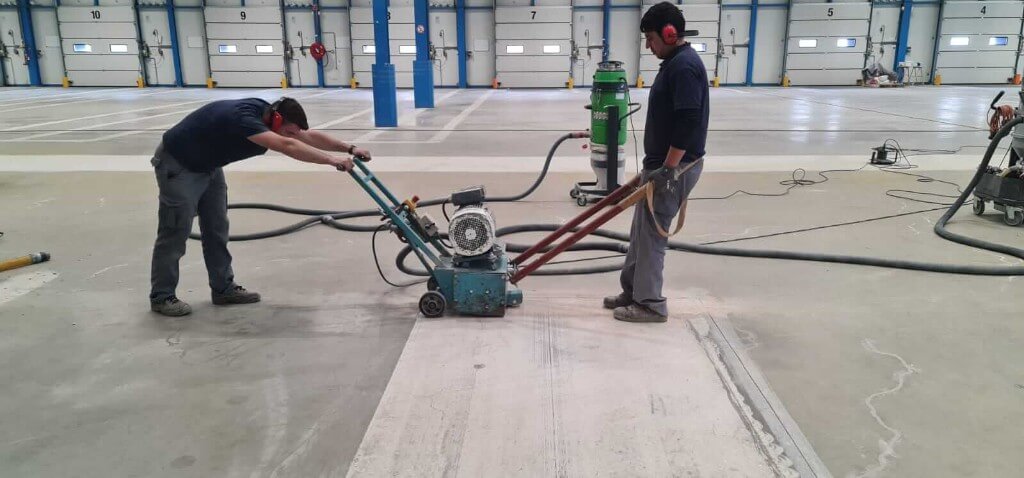
Floor preparation using the “dianovado” process, understood as preparing and making the substrate uniform, is generally carried out dry using specialist machinery:
- Scarifier: if the flooring is in very poor condition and deep material removal is required, a scarifier is used, allowing more controlled and precise removal.
- Floor grinder: if the floor has no significant defects or has a coat of paint or resin, a floor grinder is used, with grinding segments whose grit size and type depend on the hardness of the substrate and the type of coating to be removed.
Why prepare an industrial floor using the “dianovado” process?
There are various reasons for preparing a floor using this process:
- To level the substrate.
- To prepare the substrate before painting or applying a resin coat.
- To improve adhesion between the resin and the substrate.
- To remove irregularities.
- To grind the surface.
- To grind off paint or layers of epoxy or polyurethane resin.
- As a preliminary step before polishing with a lithium treatment.
- To leave the concrete with an open-pore finish to improve grip outdoors.
As specialists in refurbishment and improvement treatments for industrial flooring, at Byond we are experts in “dianovado” floor preparation. Contact us so we can understand your project's needs and provide you with the best possible advice.
- How is an epoxy floor repaired?
- Removing screws and anchors from concrete
- Removing industrial floor markings
- Grinding resin flooring and removing paint
- Repairing deteriorated concrete patches
- Repairing concrete flooring
- Repairing cracks and hairline cracks in concrete floors
- Repairing and sealing expansion joints
- Repairing potholes in concrete flooring
Image: BECOSAN