
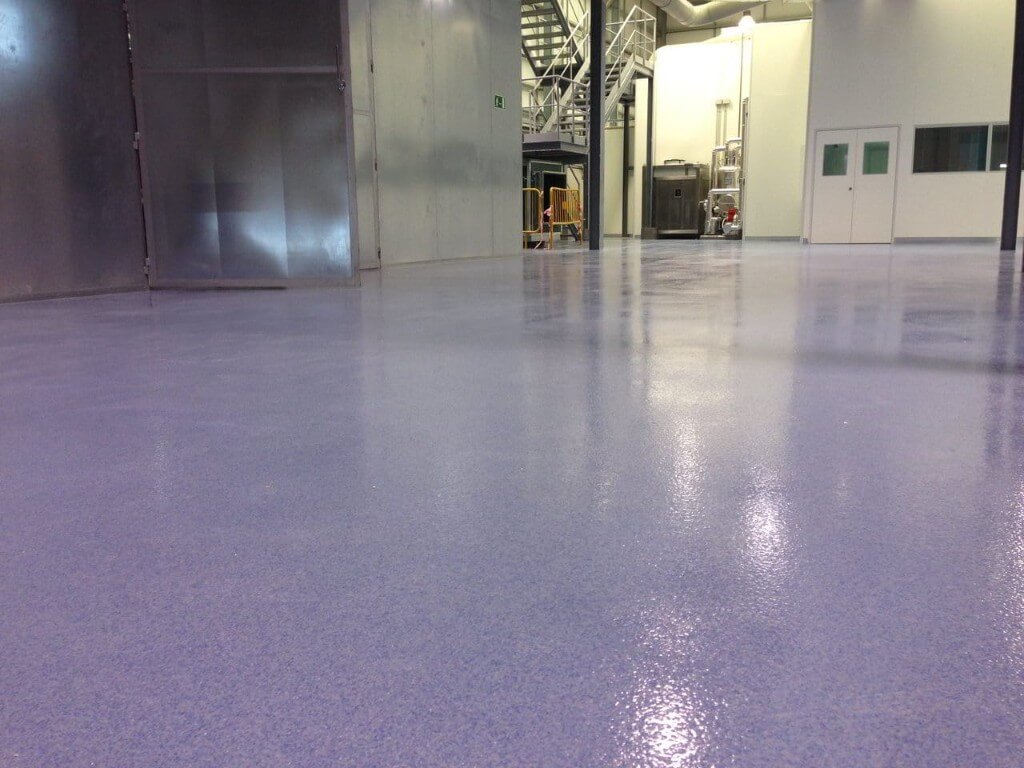
It is a quick-to-apply, versatile and affordable flooring option that provides numerous benefits for the spaces where it is installed.
Want to know why it is in such high demand? Read on to learn all about multilayer flooring.
What is multilayer flooring?
These coatings provide durability, offering attractive finishes that withstand pedestrian traffic or wear and abrasion from industrial machinery.
They are widely used in the agri-food sector because they are suitable for contact with food.
This type of flooring is not ready to install; in other words, it is prepared on the substrate.
The flooring is installed by applying several layers using resins (epoxy or polyurethane) and aggregates of different appearances and particle sizes until the desired thickness is achieved, finishing with a surface sealing coat.
It is a quick and economical technique when a floor needs levelling. These floors are also waterproof and prevent water penetration and dirt becoming ingrained, as well as being easy to clean and hygienic.
Finally, the finish is resistant to chemical attack and wear, and is slip-resistant.
Where multilayer flooring is used
The versatility of these floors is evident in the many places where they can be installed:
- Car parks.
- Shopping centres.
- Industrial kitchens.
- Hospitals.
- Pharmaceutical or chemical industrial buildings.
- Vehicle repair workshops and commercial premises.
What benefits does multilayer flooring offer?
Based on all the performance characteristics it offers alone, we can say that multilayer flooring is cost-effective.
It is also a type of flooring that does not take long to install.
However, because of its chemical components, installation involves hazards and may be carcinogenic.
Multilayer floors offer a wealth of aesthetic options and are highly resistant to wear. They are also slip-resistant, hygienic and waterproof.
How multilayer flooring is made, step by step
The process for preparing and installing multilayer flooring is as follows:
1. Surface preparation
The surface must be free of dirt and residue, so using industrial cleaning machines is advisable.
2. Application of the layers
- First: prime with resin.
- Second: level with a mixture of aggregates and resin.
- Third: sand and clean.
- Fourth: apply more resin and broadcast the aggregates until full saturation is achieved.
- Fifth: allow to harden, then sweep and vacuum up the excess aggregates.
The result is flooring approximately 2 mm to 5 mm thick that is slip-resistant, hygienic and meets almost all the requirements for installation in numerous food industries.
What materials are used to make multilayer flooring?
The components that make up this type of flooring include the following:
Depending on where it is used, it can be pigmented or transparent.
- Priming resin.
- Aggregates.
These are normally silica sands and, if coloured, they provide the colour for the resin, for example when it is transparent.
What types of resin can be applied in multilayer flooring?
Although they have many similarities, epoxy resin coatings and polyurethane floors differ in price, appearance and wear resistance.
Both resins are hygienic, waterproof, easy to clean and have a solid structure.
Generally, polyurethane resins are more elastic and offer greater resistance to temperature changes, but they need more protection against UV rays.
Epoxy resin
Epoxy resins are cheaper and provide a glossy appearance. They are widely used in car parks and garages.
Polyurethane resin
These are more resistant to scratches and impacts, although they are more expensive and do not withstand ultraviolet rays well.
One of their main uses is floor refurbishment. In addition, their thickness of between 2 and 3 mm gives the floor a glossy appearance.
How multilayer flooring should perform
This type of flooring must be easy to walk on, offering the best electrical and thermal resistance so that its grip is not affected by ambient humidity or temperature.
These epoxy resin floors are aseptic and ensure suitable disinfection and cleaning because they are homogeneous and seamless, with no cracks where microorganisms can accumulate.
What are the differences between multilayer and self-levelling flooring?
A self-levelling system is perfect for industrial floors where the substrate has many irregularities.
In this situation, using multilayer flooring would create a “telegraphing effect”, and the contours of the irregularities would be visible in the new floor.
If you need a floor that is resistant to abrasion, multilayer flooring outperforms self-levelling flooring, as its mechanical performance is superior.
Conclusions
If you are looking for a floor made with resins, multilayer flooring is one of the best alternatives because it is easy to obtain.
If you would like advice or a free quotation for multilayer flooring, please feel free to contact Byond with no obligation.