
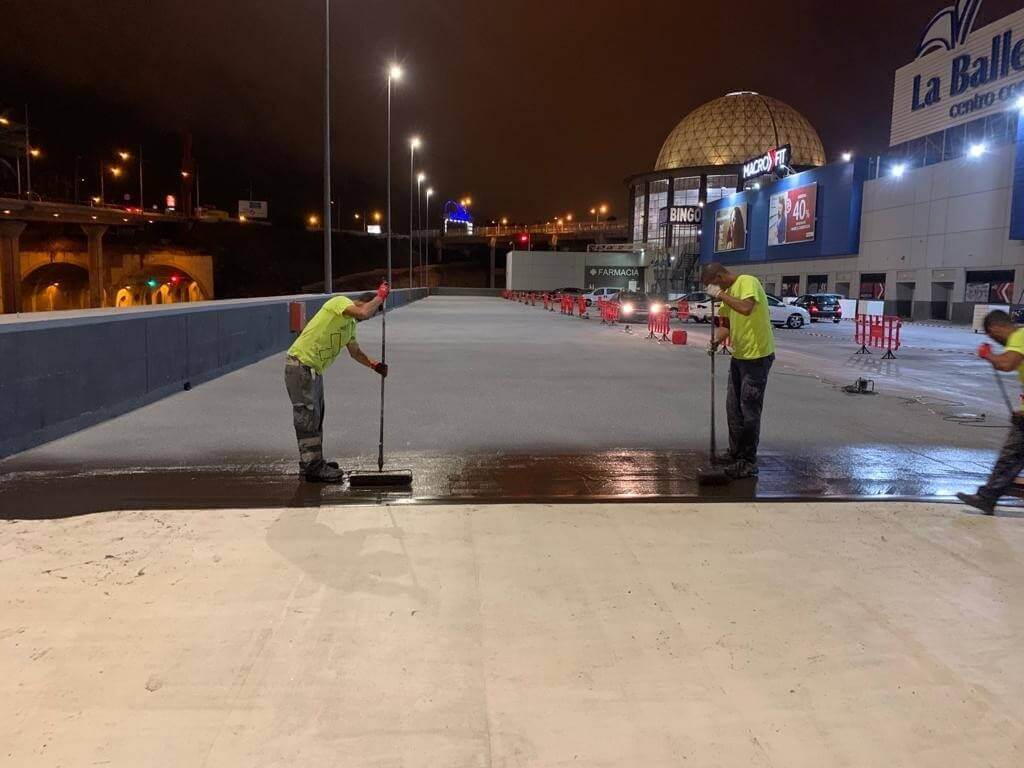
This is why, to avoid regular repairs and unnecessary expenses, you should opt for car park flooring whose main property is its exceptional resistance.
How does car park flooring differ from other flooring?
Obviously, car park flooring generally deteriorates over time. This is because vehicle traffic and the substances vehicles release (for example, oil) wear down the flooring more quickly.
As such, it is absolutely essential that car park flooring is more resistant than other types of flooring so that it lasts as long as possible and deterioration is delayed for as long as possible. The main difference compared with other types of flooring is therefore resistance.
Are there differences between indoor car park flooring and outdoor car park surfacing?
Yes. The main differences between these industrial flooring and surfacing systems are their resistance to moisture, ultraviolet rays and weather conditions, and their impermeability.
If an indoor car park needs resistant flooring, an outdoor one needs even more resistant surfacing because, as well as withstanding vehicle traffic and the substances vehicles release, it must also withstand weather conditions such as rain, sun, humidity, etc.
Common problems with car park flooring
Some of the main problems with car park flooring are as follows:
Stains from vehicle leaks
Spills of substances such as corrosive liquids or fuels are common. These make the surroundings unsightly and are dangerous for both pedestrians and vehicles themselves.
Unsafe manoeuvring
If the flooring does not have a slip-resistant finish, it is not safe. It must therefore ensure vehicle grip and manoeuvrability to prevent accidents.
Regular cleaning
Car parks are places where a great deal of dirt accumulates, such as dust, organic waste, etc.
Characteristics of car park flooring
The most important properties of car park flooring are as follows:
Mechanical resistance
It must resist abrasion caused by continuous vehicle traffic.
Slip resistance on bends and ramps
Flooring with sufficient grip is needed to prevent risks for drivers and pedestrians alike.
Quick installation
It must be installed quickly on site without affecting the other areas of the car park.
Resistance to occasional fuel spills
It must be resistant to drips of fuel, brake fluid, lubricants and other types of liquids.
Hygiene
Fuel or oil spills require flooring that is easy to clean and maintain.
Durability
It must last for many years, as it is subjected to physical loads and, in outdoor car parks, high temperatures.
Types of flooring and surfacing for use in a car park
Without doubt, seamless flooring and surfacing for car parks are among the most suitable options for use in a car park.
These systems are epoxy, polyurethane and acrylic. We discuss them below:
Epoxy resin
Epoxy resin floors are seamless coating systems for concrete, cement and mortar substrates, created by applying different variants of epoxy resin according to the flooring to be treated.
Polyurethane
Polyurethane flooring systems are seamless coating systems for concrete, cement and mortar substrates, using a mixture of epoxy and polyurethane resins according to the flooring to be treated.
Acrylic
Acrylic surfacing systems are coating systems for asphalt substrates in new construction or refurbishment, using bituminous slurry and acrylic slurry applied with a rubber squeegee.
Tips for caring for car park or garage flooring
Some of the most important recommendations for maintaining car park flooring are as follows:
Cleaning
Car park flooring must be cleaned regularly to keep it clean at all times.
Suitable products
The use of abrasive products, acids or any aggressive solvent product is not recommended because they can damage the flooring. Nevertheless, if they are used, they should not be left to act for too long.
Use suitable cleaning tools
Appropriate cleaning tools should be used, avoiding those that damage the flooring, such as sandpaper or discs that cause abrasion.
Use plenty of water
Using plenty of water when cleaning is recommended to prevent product residues from remaining. It is better to use hot or pressurised water, as it is more effective.
Byond, experts in car park flooring
At Byond, as professionals in every stage of the design, manufacture and production of bespoke seamless flooring and coatings, we offer solutions to clients looking for the most suitable car park flooring option.