
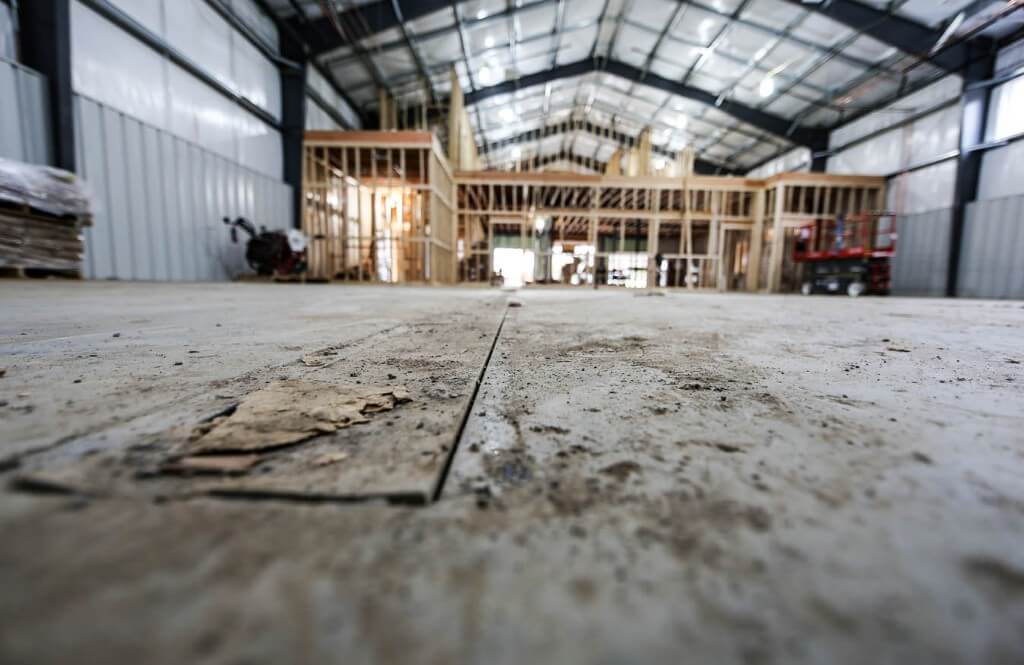
Of course, it is worth emphasising that each problem must be carefully studied and analysed before carrying out any work on the industrial flooring.
Main problems with industrial flooring
Some of the main problems affecting industrial floors are as follows:
Repairing epoxy resin floors
Epoxy resin floors, made from a highly durable, waterproof and abrasion-resistant material, are one of the most aesthetically pleasing options available.
Very occasionally, this type of flooring requires work to restore it to an as-new condition in the following ways:
- Patching the affected area with epoxy resin.
- Removing all the flooring and reapplying the epoxy resin.
- Removing all the flooring and applying an alternative to epoxy resin.
Find out more in our article on How to repair an epoxy floor.
Diamond grinding of industrial flooring and floors
Diamond grinding of industrial flooring refers to preparing the substrate before applying a resin-type coating.
This process uses two essential machines, a scarifier and a sander, to:
- Level the substrate.
- Prepare it before painting or applying a resin layer.
- Improve the bond between the resin and the substrate.
- Remove irregularities.
- Grind down the surface.
- Grind off paint or layers of epoxy or polyurethane resin.
- Prepare the surface before polishing with a lithium treatment.
- Leave the concrete with an open-pore finish to improve grip outdoors.
Learn more in our article on Diamond grinding of industrial flooring and floors.
Removing screws and anchors from concrete
Removing anchors and screws from concrete is key to renewing flooring, especially in industrial buildings.
Touch-ups and patches on this type of floor tend to be noticeable unless they are applied by true professionals.
Find out more in our article on Removing screws and anchors from concrete floors.
Removing industrial floor markings
Important elements such as lines, patches and signs form part of industrial floor markings.
These markings are vital for delineating work areas, traffic routes and other areas which, for safety reasons, must always be kept in good condition.
When repairing and refurbishing concrete flooring, lines and patches are removed if they are in poor condition.
In any event, marked areas are generally limited and removing them is fairly easy.
Once all the markings have been removed, the sanding and polishing process begins, leaving a surface ready for any other use.
Learn more in our article on Removing industrial floor markings.
Grinding resin flooring and removing paint
Grinding flooring is vital for preparing or levelling the substrate and removing resin or paint in poor condition.
This requires specialist machinery and working in sections so that business operations do not stop.
Find out more in our article on Grinding resin flooring and removing paint.
Repairing concrete patches in poor condition
Wear on concrete floors is caused particularly by the use of machinery and the movement of goods.
If the affected areas do not receive immediate attention, the problems are likely to spread across the flooring and affect the entire facility.
This is a particularly sensitive issue in operations involving high-level storage, as the risk of accidents increases.
Therefore, patches in poor condition must always be repaired using non-shrink mortars which, once dry, provide extreme rigidity.
Learn more in our article on Repairing patches in poor condition on concrete floors.
Repairing concrete flooring
A floor in poor condition brings numerous problems relating to hygiene, workplace safety and aesthetics.
If left untreated, these problems will worsen, and sooner rather than later the surface will need to be renewed, with the financial cost and production downtime this entails.
Problems with concrete arise, for example, from incorrectly performed procedures, defects in the existing surface, misuse of the flooring, materials in poor condition, inadequate concrete slab design, excessive moisture, extreme temperatures, etc.
Find out more in our article on Repairing concrete flooring.
Repairing cracks and fissures in concrete floors
Cracks in floors pose major safety problems in car parks, shopping centres, industrial buildings, etc.
Repairing fissures in concrete floors is a demanding task that must be carried out effectively and precisely by professionals.
Learn more in our article on Repairing cracks and fissures in concrete floors.
Repairing and sealing expansion joints
Like any structural element, expansion joints in concrete flooring are subject to progressive deterioration over time.
This leads to the expected wear, which requires measures to repair the expansion joints.
Joint wear varies according to environmental influences. It is also associated with surface abrasion, as this is what causes surface disintegration in its early stages.
Find out more in our article on Repairing and sealing expansion joints.
Repairing potholes in concrete flooring
Concrete flooring suffers damage from constant use, which takes the form of holes, breaks, cracks or potholes.
These defects make it difficult for the various types of vehicles that typically move through industrial, commercial and logistics facilities, etc., to pass.
These irregularities can also cause workplace accidents, resulting in legal complications.
Learn more in our article on Repairing potholes in concrete flooring.
What can be done to prevent these problems?
In this article, we have explained how each of the most common problems with industrial floors is addressed.
Whatever problem is affecting your flooring, at Byond we specialise in repairing all types of flooring problems.